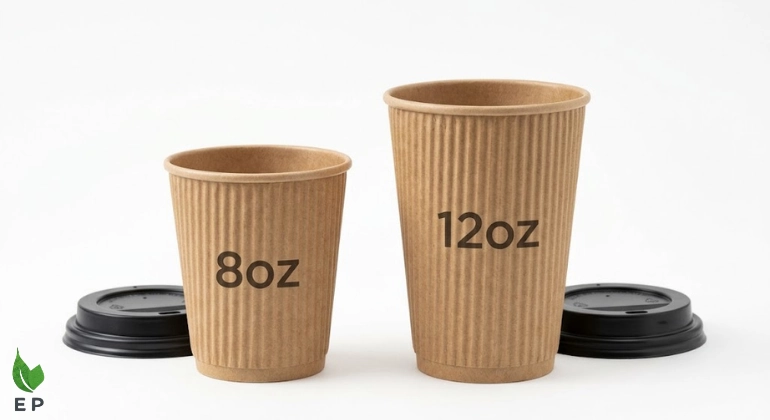
If you’ve ever stood in front of a packaging catalog or a supermarket shelf wondering whether to pick the smaller cup or the bigger one, you’re not alone. The debate around 8oz vs 12oz coffee cups comes up constantly — for home users trying to control their coffee portions, and for cafe owners trying to balance cost, customer satisfaction, and brand presentation. The truth is, there’s no universal “better” size. Each one serves a different purpose, a different drink, and a different kind of customer. This guide breaks down everything you need to know, from capacity and material to real business use-cases, so you can make a decision that actually fits your needs instead of just guessing.
Coffee cup sizing might seem like a small detail, but it quietly affects your costs, your customer experience, and even how your drink tastes. A cup that’s too small frustrates customers who want a full serving, while a cup that’s too large can make your espresso look lost and your costs go up unnecessarily. Let’s unpack this step by step, starting with the basics of what these sizes actually mean.
Before comparing the two sizes directly, it helps to understand what “oz” actually represents in a coffee cup size guide. One fluid ounce equals roughly 29.5 milliliters, which means an 8 oz coffee cup size holds about 236ml, while a 12 oz coffee cup size holds close to 354ml. That’s a meaningful difference — not just in liquid volume, but in how the drink feels in hand, how much insulation it needs, and how long it stays hot.
Standard coffee serving size varies by drink type too. An espresso shot is typically served in just 1-2oz, a cappuccino comfortably fits in an 8oz cup, while a regular brewed coffee or a milk-heavy latte often needs the extra room a 12oz cup provides. This is exactly why so many cafes stock multiple sizes rather than committing to just one — different drinks genuinely need different containers to taste and look right.
The 8oz cup is often considered the “classic” coffee cup size, especially in cafes that specialize in espresso-based drinks. It’s compact enough to feel intentional rather than oversized, which matters more than people realize — a tiny espresso shot in a huge cup looks awkward and makes the drink seem skimpy, even if the pour is accurate.
For home users, the 8oz size is usually the sweet spot for people who enjoy a quick morning coffee without wanting to commit to a large mug that takes forever to finish. It’s also the preferred choice for single serving coffee cups in offices, waiting rooms, and small meeting setups where space and portion control matter more than indulgence.
From a packaging and cost perspective, smaller cups mean less raw material per unit, which translates into lower per-cup costs for bulk coffee cups — something that matters a lot for businesses serving hundreds of cups daily. If you’re running a coffee shop and want a reliable supply, PackagingBox.pk’s 8oz insulated ripple double-wall paper coffee cup with lid is a solid example of how this size balances insulation, comfort, and affordability in one package.
The 12oz cup has become something of an industry standard for regular drip coffee, lattes, and cold brew servings. It gives enough room for milk, foam, or ice without feeling cramped, which is why most cafes default to this size when a customer doesn’t specify a preference. If you’ve ever ordered a “medium” at a coffee shop without thinking twice, there’s a good chance it arrived in a 12oz cup.
For people who like to sip their coffee slowly over a longer period — reading, working, or commuting — the 12oz size reduces the need for refills and keeps the drink at a drinkable temperature for longer, especially when paired with proper insulation. This is also the size most travel mug users gravitate toward, since it roughly matches the capacity of a standard travel mug without feeling like overkill.
Business-wise, 12oz cups tend to be the better choice for cafes targeting high-volume, high-retention customers who want value for money. A larger pour feels more generous, which subtly influences repeat visits and customer loyalty. PackagingBox.pk offers both a 12oz insulated ripple double-wall paper coffee cup with lid and an imported 12oz double-wall brown coffee cup for businesses that want a slightly more premium, imported finish.
Numbers often make a decision clearer than paragraphs alone, so here’s a direct comparison of both sizes across the factors that matter most to buyers and business owners.
| Factor | 8oz Coffee Cup | 12oz Coffee Cup |
|---|---|---|
| Approximate Capacity | 236 ml | 354 ml |
| Best Suited Drinks | Espresso, cappuccino | Latte, drip coffee, cold brew |
| Ideal User | Light coffee drinkers, offices | Daily drinkers, commuters |
| Material Cost per Unit | Lower | Slightly higher |
| Heat Retention Duration | Shorter | Longer (with double-wall) |
| Common Business Use | Specialty/small servings | Standard everyday orders |
As the table shows, neither size is objectively “better” — the right pick depends entirely on your drink type, your customer base, and how your business wants to position itself. A specialty espresso bar leaning into 8oz cups sends a very different brand message than a high-volume commuter cafe defaulting to 12oz.
Running a cafe or a cloud kitchen adds another layer to this decision, because now it’s not just about personal preference — it’s about margins, customer expectations, and operational efficiency. Many new cafe owners make the mistake of stocking only one size, which either frustrates light drinkers who feel overcharged for a small coffee, or disappoints heavy drinkers who feel shortchanged on volume.
A smarter approach, which we cover in more depth in our guide on choosing the right coffee cup size for your cafe, is to stock both sizes and let the menu guide the choice — espresso-based drinks naturally go into 8oz cups, while milk-based and brewed coffee options go into 12oz. This also opens the door to tiered pricing, which customers generally find fair and intuitive.
Branding plays a role here too. If your cafe wants to stand out, custom printed coffee cups in either size can turn a simple takeaway order into a walking advertisement. PackagingBox.pk’s custom printed 8oz coffee cups and custom printed 12oz coffee cups make it easy to maintain consistent branding across both serving sizes, which matters more for long-term customer recall than most owners initially expect.
Home use tends to be a simpler decision, but it’s still worth thinking through rather than grabbing whatever’s cheapest. If you drink coffee once a day as a quick pick-me-up, the 8oz size usually fits better — it finishes before it goes cold, and it doesn’t encourage over-pouring sugar or cream just to fill space. On the other hand, if your coffee ritual involves slow mornings, work-from-home sessions, or sipping over a longer stretch, the 12oz size holds up better and reduces the hassle of constant refills.
Families or small offices that buy disposable coffee cups sizes in bulk often find it practical to keep both sizes on hand — smaller cups for kids’ hot chocolate or quick guest servings, and larger ones for the household’s main coffee drinkers. It’s a small inventory decision, but it noticeably reduces daily friction once you’ve tried it.
Size is only half the equation — material and construction change how both sizes actually perform in daily use. Paper coffee cups remain the most common choice for takeaway coffee cups because they’re lightweight, affordable, and widely recyclable compared to plastic alternatives. If you’re curious how paper stacks up against plastic in real-world performance, our breakdown of paper vs plastic coffee cups covers the practical differences in detail.
Within paper cups, the construction style matters just as much as the size. Single-wall cups are thinner and cheaper but transfer heat faster, which can be uncomfortable to hold without a sleeve. Double-wall and ripple cups solve this by trapping air between layers for better insulation, which is particularly useful for hot beverage cups served without lids or sleeves. Our detailed comparison of double-wall vs single-wall coffee cups and ripple cups vs double-wall cups explains which option suits different budgets and serving needs.
Sustainability has also become a genuine purchasing factor rather than just a marketing buzzword. Businesses increasingly look for eco-friendly coffee cup options that reduce environmental impact without compromising on insulation or presentation — a trend that’s only growing as customers become more conscious of packaging waste.
One detail worth mentioning: the cup you drink from can genuinely affect taste perception. If you’ve ever wondered why coffee tastes different in a disposable cup compared to ceramic, the material and even the cup size play a bigger role than most people assume.
A coffee cup rarely works alone — lids and carriers complete the experience, and choosing the wrong combination can undo the benefits of picking the right cup size in the first place. Flat lids, dome lids, and sip lids each change how the drink is consumed and how much heat escapes, which is covered thoroughly in our guide to coffee cup lid types. Generally, dome lids suit drinks with foam or whipped cream, while sip lids work better for straightforward black coffee or cold brew.
For cafes handling multiple takeaway orders, a reliable coffee cup carrier or a 4-cup drink carrier makes a noticeable difference in order accuracy and customer convenience, especially for delivery and drive-through setups. These small additions rarely get the spotlight, but they shape the overall unboxing experience just as much as the cup itself.
If you’re still torn between the two sizes, running through a few quick questions usually settles it:
Honestly, there isn’t a single winner in the 8oz vs 12oz coffee cups debate — and that’s actually good news, because it means you get to choose based on real usage rather than forcing your coffee habit or your business menu to fit one rigid size. If your focus is espresso-style drinks, portion control, or minimizing packaging costs, the 8oz cup is the practical choice. If your customers or household lean toward larger, milk-based, or slow-sipped coffee, the 12oz size delivers better comfort and perceived value.
The smartest long-term approach, especially for cafes and food businesses, is to stock both sizes and let your menu dictate usage rather than guessing. Pairing the right size with proper insulation, the right lid type, and consistent branding does more for customer satisfaction than most owners initially expect — and it’s a decision that pays off every single day, one cup at a time.
Ready to stock the right coffee cup sizes for your cafe or home? Explore PackagingBox.pk’s complete range of coffee cups and customized coffee cup collection to find the perfect fit for your brand and your customers.
Q1. What size coffee cup should I use for daily drinking? For most daily coffee drinkers, an 8oz cup works well for espresso-based drinks, while a 12oz cup suits larger milk-based or brewed coffee servings.
Q2. What is the actual difference between 8oz and 12oz coffee cups? The main difference is capacity — an 8oz cup holds about 236ml while a 12oz cup holds roughly 354ml, which affects portion size, insulation needs, and ideal drink type.
Q3. Is a 12oz coffee cup too big for everyday use? Not necessarily. A 12oz cup suits people who sip coffee slowly or prefer lattes and cold brew, while light drinkers may find 8oz more practical.
Q4. How many ml are 8oz and 12oz coffee cups? An 8oz coffee cup equals approximately 236ml, while a 12oz coffee cup equals approximately 354ml.
Q5. Which coffee cup size is best for a cafe business? Most successful cafes stock both sizes, using 8oz for espresso-based drinks and 12oz for brewed coffee and lattes, to match different customer preferences.
Q6. Which cup size is more cost-effective for bulk ordering? 8oz cups generally cost less per unit due to lower material usage, making them more economical for high-volume businesses.

Subscribe our newsletter & get notification about information discount.
Subscribe to get special offers, free giveaways, and once-in-a-lifetime deals.