You spend hours baking, levelling, filling and decorating a cake. It looks stunning on the counter. Then you lift it, and the board bends in the middle, the cake tilts, and your heart drops. We have all seen it happen, and it almost always comes down to one small choice: the thickness of the board underneath.
This cake board thickness guide will help you match the right board to the right cake. You will learn what thickness works for light sponges, heavy fondant cakes and tiered wedding cakes, how cake boards differ from cake drums, and how to avoid sagging, bending and soggy bases. Whether you are a home baker or a busy bakery, you will know exactly what to order by the end.
A cake board is not just a pretty base. It is the structure that carries the full weight of your cake, keeps it level while you decorate, and protects it when you move it. A board that is too thin flexes under weight. Even a slight bend can crack fondant, shift fillings and crush the bottom layer.
Thickness also affects presentation. A thin board disappears under a small cake, while a thick, foil-covered drum gives a bold, professional frame. Choosing the right cake board thickness is therefore about strength, stability and style at the same time.
This is one of the most common questions bakers ask, and the confusion is understandable because the names are often used loosely.
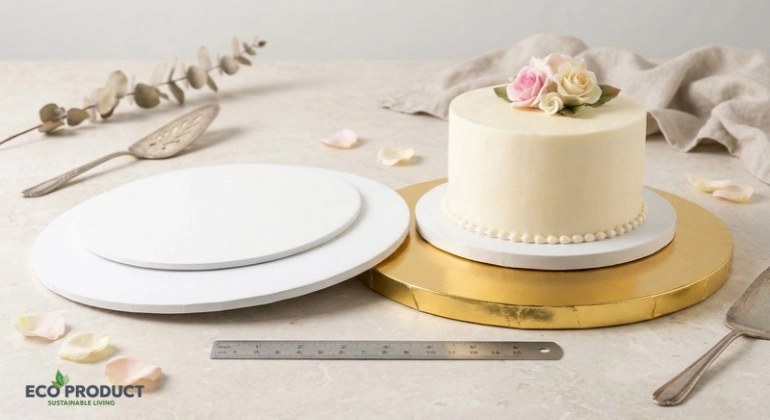
A cake board (sometimes called a cake card) is a thin, flat base, usually around 2 to 4 mm thick. It is made of laminated card, ideal for lighter cakes, cupcakes, cake slices and as a base inside a box.
A cake drum is much thicker, typically 10 to 13 mm, with smooth, finished edges. It is built to carry heavy cakes, fondant-covered designs and tiers. The extra depth also gives that polished, showpiece look.
If you want the full breakdown, read our guide on the difference between a cake drum board and a regular cake board. Here is a quick comparison:
| 📏 Feature | 🎂 Cake Board (Card) | 🏗️ Cake Drum |
|---|---|---|
| Typical thickness | 2–4 mm | 10–13 mm |
| Best for | Light cakes, cupcakes, slices | Heavy, tiered, fondant cakes |
| Strength | Light to medium | Very high |
| Edge finish | Plain cut edge | Wrapped, smooth edge |
| Look | Simple base | Display-ready frame |
So how thick should a cake board be? It depends mostly on cake weight, structure and how far the cake must travel. Use this chart as a starting point.
| 🍰 Cake Type | ⚖️ Approx. Weight | ✅ Recommended Thickness |
|---|---|---|
| Cupcakes, cake slices | Under 500 g | 2–3 mm board |
| Small sponge or buttercream cake (1–2 lb) | 0.5–1 kg | 3–4 mm board |
| Medium cake (2–3 lb), single tier | 1–1.5 kg | 4–6 mm board or thin drum |
| Heavy fondant cake (4–6 lb) | 2–3 kg | 10–12 mm drum |
| Tiered or wedding cake | 3 kg and above | 12 mm drum (plus boards between tiers) |
These are practical guidelines, not strict rules. Always add a margin of safety if the cake has heavy fillings, fresh fruit or thick fondant.
A 3mm cake board works well for lightweight cakes. Think single-layer sponges, small birthday cakes, cheesecakes, tarts and cupcake groups. These cakes do not put much pressure on the base, and the board mainly helps you lift and slide them neatly into a box.
Thin boards are also popular for bakery cake bases because they are economical and easy to cut to size. If you sell many everyday cakes, they keep costs low without risking the cake. Just remember to fit the board to the cake box properly. Our complete cake box guide for bakeries explains how to match board and box sizes so nothing slides around.
Once cakes get heavy, thin card simply cannot cope. A 12mm cake drum is the standard choice for fondant cakes, sculpted designs, multi-layer celebration cakes and tiered cakes. Its rigid structure stops bending, even when you lift the cake from one side.
A drum is also the right pick when your cake will be displayed. The wrapped edge gives a neat border, and you can choose gold, silver, black or white finishes to match your design. If you are comparing options, our cake drum board collection includes the golden cake drum board, silver cake drum board, black cake drum board and white cake drum board.
A useful trick: if you cannot decide between a thick board and a thin one, go thicker. A slightly over-built base never ruined a cake, but an under-built one has ruined plenty.
Tiered cakes are where thickness becomes critical. The bottom tier carries every layer above it, so it needs a strong foundation.
For the base, use a 12 mm cake drum that is at least 2 to 4 inches wider than the bottom tier. This gives you space for decoration and room to handle the cake. Between tiers, place a thinner board under each cake, usually 3 to 4 mm, and support the structure with cake dowels pushed through the lower layers. The dowels carry the weight, and the thin boards keep each tier separate and stable.
Without that structure, the upper tiers press down on the lower cake, causing bulging, cracks and leaning. For wedding cakes, never skip dowels, even if the cake feels light.
Thickness is half the story. Size matters too, and many bakers get it wrong.
As a general rule, a board for a single cake should be about 1 to 2 inches larger than the cake. This gives you a border for decoration, space to hold the board and protection for the edges. For heavily decorated cakes or drums, add 2 to 3 inches.
| 🎂 Cake Size | 📐 Suggested Board Size |
|---|---|
| 6 inch cake | 8 inch board |
| 8 inch cake | 10 inch board |
| 10 inch cake | 12 inch board |
| 12 inch cake | 14 inch board |
Do not choose a board far larger than needed. If it is too big, it will not fit the box, and cakes inside will slide. In the other direction, a board the exact same size as the cake leaves no margin, and one wrong move can damage the icing.
For a 2 lb or 3 lb cake, which usually measures around 7 to 8 inches, a 9 to 10 inch board is a safe fit.
Thickness is only useful if the material holds up. Here are the common types you will find:
Always choose food-safe boards. Cream, ganache and fondant contain moisture and fat, and a poor-quality board can absorb it quickly.
A soggy board is not only ugly, it is weak. Moisture from fresh cream, fruit, syrup or humid weather soaks into card, making it soft and prone to bending. This is especially common in Pakistan’s warm, humid months.
To prevent it, choose foil-covered or greaseproof-coated boards, which resist moisture much better than plain card. Cover the board with foil or fondant before placing the cake, and use a thin layer of icing or a cake card between the cake and a plain drum. Keep cakes chilled until delivery, and avoid leaving them in sunny, damp spots.
Delivery puts boards under real stress. Bumps, turns and heat all test the base. For cake delivery, use a board that is sturdy enough not to flex when lifted, and match it to the box so the cake cannot slide.
Many bakers secure the cake with a dab of icing or a non-slip mat between the cake and the board. They then place the board in a snug box. For a full walkthrough, see our guide on how to package a cake for delivery without damage. For simple cakes, a cake board paired with a good box is usually enough. For tall or heavy cakes, upgrade to a drum.
A well-chosen board is only helpful if the cake stays put. Follow these simple steps:
You may also use a thin cake card between the cake and a drum, so the cake can be lifted off easily later.
Quality matters, and so does price. When buying cake drum boards in Pakistan, check that the board is sturdy, the edges are clean and the surface is food-safe. Buying in bulk lowers the cost per piece, which is helpful for bakeries.
At EcoProduct.pk, you can explore our full bakery packaging range for boards, boxes and bags in one place. For everyday cakes, choose from our white cake board, golden cake board or silver cake board. Pair them with our cake boxes, and finish with a white paper cake bag for a neat, professional delivery.
Use 3 to 4 mm boards for light cakes, 4 to 6 mm for medium single-tier cakes, and a 10 to 12 mm cake drum for heavy, fondant or tiered cakes.
A 12 mm cake drum is the standard for the base of tiered cakes. Use thinner boards between tiers and support them with dowels.
A cake board is thin (2–4 mm) and suits light cakes. A cake drum is thick (10–13 mm) with finished edges and suits heavy or tiered cakes.
It is not recommended. A thin board will bend and may crack fondant or shift the layers. Use a cake drum instead.
A 10 inch board is the usual choice, giving about 1 inch of border on each side.
Yes. A board 1 to 2 inches larger than the cake protects the edges and makes the cake easier to handle. Heavily decorated cakes may need 2 to 3 inches extra.
Quality cake boards and drums are made for cake use, but always check that they are labelled food-safe, especially for creamy or moist cakes.
Moisture from cream, fruit or humid weather soaks into plain card. Use foil-covered or greaseproof boards and keep cakes chilled.
Choosing the right board is one of the easiest ways to improve your cakes. Use thin 3–4 mm boards for light cakes, step up to 12 mm drums for heavy and tiered designs, size boards one to two inches larger than the cake, and pick moisture-resistant materials for humid weather. Follow this cake board thickness guide and your cakes will travel safely, stand strong and look professional every time.
Stock up on strong, reliable boards and drums for every cake you bake. 👉 Shop cake boards and drums at EcoProduct.pk and give every cake the foundation it deserves. Planning a bulk order for your bakery? Visit our shop and get in touch today.

Author at Eco Product — passionate about sustainable living and eco-friendly products.

Subscribe our newsletter & get notification about information discount.
Subscribe to get special offers, free giveaways, and once-in-a-lifetime deals.