Tin boxes for packaging combine strong product protection, attractive presentation and long-term reusability in one practical container. Whether you sell chocolates, tea, coffee, candles, cosmetics, dry fruits or corporate gifts, the right tin box packaging can make your product feel more valuable while protecting it during storage and handling. However, selecting between different packaging tin boxes, materials, shapes, lids, coatings and order quantities requires more than choosing the most attractive design.
Modern customers notice packaging before they experience the product inside it. A carefully selected tin can communicate quality, improve shelf presence and create a memorable unboxing experience. Unlike many disposable packaging materials, metal tins may also remain useful after the original contents have been consumed.
For businesses, this creates an opportunity to turn packaging into a lasting brand asset. A customer may reuse an attractive tin for jewelry, spices, stationery, sewing supplies or household storage. Your brand can remain visible long after the first purchase—something an ordinary wrapper rarely achieves.
This buyer’s guide explains how to select custom tin boxes and ready-made tin packaging boxes according to product type, food-contact requirements, branding goals, budget and expected order volume.
Tin boxes are rigid metal containers commonly made from tinplate. Tinplate is a thin steel sheet covered with a protective tin coating. Although these containers are called “tin boxes,” they are generally not manufactured from solid tin.
The steel base provides strength and structural stability. The tin coating and additional protective lacquer help improve corrosion resistance, surface appearance and printability. This combination creates a durable packaging solution that can withstand normal retail handling better than many lightweight alternatives.
Tin containers for packaging are available in different shapes, sizes and closure styles. A container may have a removable lid, hinged lid, slip lid, screw-top lid or snap-fit closure. Each design creates a different user experience and level of convenience.
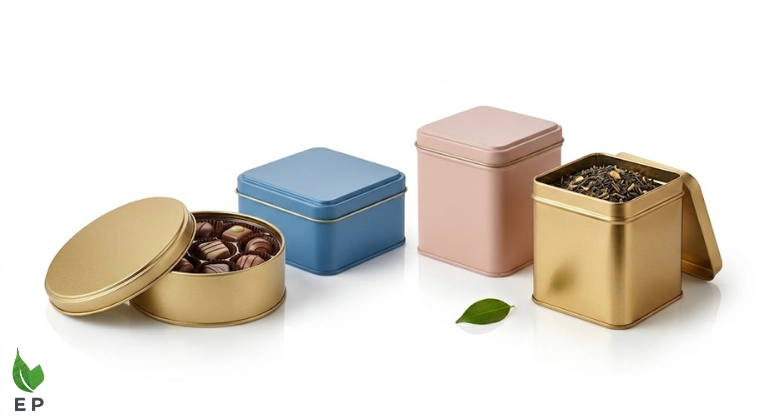
For example, a candle business may prefer round tin containers with removable lids because they are easy to open and reuse. A chocolate brand may select square metal tin boxes with a fitted insert to keep each piece in position. A tea company may prioritize a snug-fitting lid and suitable internal coating to help preserve product quality.
Businesses can explore Eco Product’s range of tin boxes for packaging to compare available round, square and decorative designs for food, retail and gifting applications.
Packaging is no longer expected to perform only one function. It must protect the product, communicate brand value, remain convenient for the customer and support responsible material use. Tin box packaging can meet several of these requirements when it is selected carefully.
One of its strongest advantages is packaging durability. A rigid tin can protect delicate products from crushing, pressure and minor impact during display, storage and everyday handling. This makes metal packaging particularly useful for chocolates, biscuits, confectionery, candles and gift assortments.
Tin packaging also creates a premium visual impression. A standard product placed inside a polished, printed or embossed container can immediately feel more gift-worthy. Matte finishes may produce a modern appearance, while glossy or metallic finishes can create a more traditional luxury presentation.
Reusable tin packaging offers another valuable benefit. Customers frequently keep decorative tin boxes and use them as storage containers. This extended life can reduce the need for another household container and keep branded packaging in use for longer.
Tinplate is also recyclable through appropriate metal recycling systems. However, businesses should avoid unsupported environmental claims. Recyclability depends on local collection facilities, coatings, contamination and proper disposal. Clear reuse and recycling instructions are more helpful than broad claims such as “completely waste-free.”
Together, these qualities make tins particularly valuable when appearance, protection and customer experience matter as much as basic containment.
The performance of packaging tin boxes begins with the raw material. A responsible tin box manufacturer should explain the material grade, metal thickness, internal coating and intended application—not simply offer a color and approximate size.
Tinplate consists of a steel sheet coated with a thin layer of tin. The steel provides rigidity, while the treated surface supports corrosion resistance and metal box printing.
Metal thickness can affect weight, strength, dent resistance and unit price. Large tin packaging boxes may require greater rigidity than small mint tins. However, thicker metal is not automatically necessary for every product. Shape, seams, lid structure and manufacturing quality also affect overall performance.
A well-formed tin should open and close smoothly. Its edges should feel safe, its seams should be consistent, and the body should not distort during normal use. Buyers should inspect these details during sample evaluation instead of focusing only on appearance.
A protective lacquer creates a barrier between the contents and the metal surface. This can be especially important for food, cosmetics, candles and products containing oils, fragrances or moisture.
The required coating depends on the product. A lacquer suitable for dry biscuits may not be appropriate for an oily balm, acidic food or fragranced candle. Businesses should tell the packaging supplier exactly what will be placed inside the container.
For food-safe packaging, request documented information about the coating, intended food-contact use and applicable test standards. Terms such as “food-grade metal,” “BPA-free coating” or “FDA-compliant packaging” should be supported by relevant supplier documentation and test reports.
Regulatory requirements may vary by product and destination market. A claim accepted in one country may not satisfy the import regulations of another. Buyers planning to export should verify the requirements for every intended sales region.
Tinplate packaging is durable, but it is not immune to corrosion. Persistent moisture, unsuitable ingredients, damaged coatings or poor storage conditions can affect the metal.
Rust-resistant tin boxes depend on suitable material selection, proper lacquer, controlled manufacturing and dry storage. Buyers should conduct compatibility testing using the real product under expected temperature, humidity and shelf-life conditions.
This is especially important for products containing salts, acids, essential oils or water. A short visual inspection cannot replace a realistic product-packaging test.
Shape influences product fit, shelf presentation, shipping efficiency and customer experience. It should be selected according to practical requirements rather than appearance alone.
Round tins have a soft, classic appearance. They are commonly used for candles, tea, coffee, confectionery, cosmetics, spices and small gifts. Their curved walls can support attractive wraparound labels, while removable or screw-top lids make repeated use convenient.
Eco Product’s round tin boxes are suitable for businesses seeking elegant, reusable packaging. The Golden Round Tin Box is available in several capacities and can be considered for candles, dry foods, cosmetics, gifts and retail packaging.
Imagine a candle company launching three fragrances. Instead of developing a different container for every scent, the business can use one round tin format and change the label, color band or printed artwork. This keeps the range visually consistent and can reduce unnecessary tooling expenses.
Square tins use storage and shelf space efficiently. Their flat sides offer useful areas for labels, ingredients, instructions and custom logo printing. They are frequently selected for chocolates, sweets, dry fruits, biscuits, jewelry and gift collections.
Businesses can compare available formats in the square tin box collection. A Blue Square Tin Box can support modern chocolate or confectionery presentation, while the Pink Square Tin Box suits celebratory gifts, wedding favors and seasonal collections.
For products requiring a warmer luxury appearance, Square Golden Tin Boxes can be used for sweets, dry fruits, candles, cosmetics and gift packaging solutions.
Rectangular tin boxes are useful when products must be arranged in rows or layers. Tea sachets, biscuits, stationery, confectionery bars and coordinated gift products can fit efficiently inside a rectangular format.
The shape also provides a broad front-facing area for brand packaging. However, buyers should inspect corners and seams carefully, as complex structures must be manufactured accurately to avoid sharp areas or uneven lids.
Small tin boxes for packaging are commonly used for mints, spices, balms, jewelry, product samples and promotional items. They use less material, but unusual custom dimensions may still require tooling and minimum order quantities.
Large tin packaging boxes work well for family-size biscuit packs, premium hampers, corporate gifts and festive collections. Their size can increase shipping volume, so buyers should calculate outer-carton dimensions before approving the design.
A slightly smaller tin with a well-designed insert may offer better product presentation than an oversized container filled with unnecessary empty space. The box should look generous, not lonely.
Choosing the correct size requires more than measuring the product’s width and height. Buyers must also consider clearance, inserts, labels, product movement and closure depth.
Start with the exact dimensions of the product or intended fill volume. If individual items will be arranged inside, create a basic layout showing how many units will fit in each row and layer.
Allow suitable clearance so the product can be inserted and removed without damage. At the same time, avoid excessive empty space because it can make the product appear smaller and allow it to move during transportation.
Custom inserts can improve the fit. Cardboard dividers, molded trays or foam inserts may hold chocolates, cosmetics, jewelry and promotional gifts in position. The insert material should be selected according to product sensitivity, sustainability objectives and recycling considerations.
Before placing a bulk order, test a physical sample using the actual contents. Check the weight, closure, product movement and overall customer experience. Measurements on a screen can look perfect while the physical pack tells a completely different story.
The closure affects product protection, convenience and perceived quality. A lid that is too loose may detach during handling, while one that is excessively tight can frustrate customers or deform the container.
A removable lid is simple, familiar and cost-effective. It works well for candle tins, gift boxes, dry foods and storage containers. The lid should fit securely while remaining easy to remove.
A slip lid fits over the top edge of the container. It provides a clean appearance and broad surface for labels or printing. However, it should not automatically be described as airtight or tamper-resistant unless testing confirms those properties.
Hinged tin boxes keep the lid attached to the container. They are convenient for mints, stationery, small tools, cosmetics and collectible items.
The hinge should be tested through repeated opening and closing. Poorly formed hinges may loosen, become misaligned or develop rough movement. A reliable supplier should be able to explain how hinge quality is checked during production.
Screw-top lids can provide a more controlled closure and are often considered for balms, cosmetics, spices and small storage containers. Thread alignment and opening force must be consistent across the production batch.
Snap-fit lids create a satisfying closing action and can work well for chocolates, sweets and gift packaging. They should be tested for security during normal shipping and handling.
If the product requires genuine airtight, moisture-resistant or tamper-evident performance, request relevant testing. A tight-feeling lid alone is not technical proof of barrier performance.
Metal packaging boxes are highly versatile. Their suitability still depends on product characteristics, internal coating, closure performance and intended shelf life.
Food-grade tin boxes can be used for dry products such as biscuits, cookies, chocolates, sweets, tea, coffee, spices, mints and dry fruits when the materials and coatings are suitable for food contact.
Tea tin boxes and coffee tin containers may help create a premium retail experience. However, products sensitive to oxygen or moisture may need an inner sealed pouch. The tin then provides secondary protection and presentation rather than acting as the only freshness barrier.
Biscuit tin boxes and cookie tin packaging help reduce crushing during handling. Chocolates can be presented with paper cups, trays or food-compatible inserts to prevent movement and improve hygiene.
Businesses selling baked goods can also compare tins with other forms of bakery packaging to choose the most practical format for each product.
Candle tins are portable, reusable and visually attractive. The metal, coating, wick placement and container dimensions must be appropriate for the candle formulation. Burn testing should always be completed before commercial sale.
Cosmetic tin packaging can be used for balms, solid perfumes, soaps and selected dry formulations. Compatibility testing is essential because oils, fragrances and active ingredients may interact with unsuitable coatings.
Soap tin boxes should allow the intended use conditions to be considered. A tin repeatedly exposed to water in a bathroom may require drainage, an inner tray or clear drying instructions.
Tin gift boxes work particularly well for corporate gifts, wedding favors, jewelry, watches and promotional sets. A fitted insert can transform a basic container into premium product packaging.
Promotional tin boxes also provide lasting brand visibility. A useful container with subtle branding is more likely to be reused than one covered with a campaign message that quickly becomes outdated.
Collectible tin boxes can support limited product editions and seasonal releases. Distinctive artwork, numbered designs and embossed details may encourage customers to retain the packaging.
Custom tin packaging can range from applying a printed label to developing a completely bespoke tin shape. The correct level of customization depends on order volume, budget, brand maturity and launch timeline.
A new business does not always need a fully custom mold. Ready-made tins with professional labels, sleeves or screen printing can deliver strong presentation with lower setup costs.
Established brands ordering custom printed tins in bulk may benefit from direct printing, custom dimensions and embossed details. These features create a distinctive appearance but normally require higher minimum order quantities and longer manufacturing lead times.
Printed tin boxes should be evaluated under realistic lighting. Metallic surfaces can change how colors appear, so a physical proof or production sample is more reliable than a digital mock-up.
An embossed logo raises selected parts of the metal surface, while a debossed logo presses the design inward. Both techniques can create a tactile premium effect. Embossed tin boxes are especially effective when the branding is simple enough to remain readable.
Packaging artwork should include more than a logo. Depending on the product and regulations, it may require ingredients, warnings, net weight, contact details, barcode, batch information, storage guidance and recycling instructions.
The best printing method depends on quantity, design complexity, available tin shape and budget. No single option is ideal for every order.
Offset printing is commonly used for detailed, high-volume custom printed tin boxes. It can reproduce complex artwork and consistent brand colors, but setup requirements may make it less suitable for very small runs.
Screen printing works well for simple logos and limited colors. It can provide bold coverage and is often used for branded tins with clean, minimal artwork.
Digital printing may be useful for shorter runs, prototypes or variable designs, depending on the supplier’s equipment and the container’s surface. Availability can vary, particularly for already formed tins.
Labels and sleeves are practical for low MOQ custom tin boxes. They allow businesses to use ready-made tins and update artwork without manufacturing a new container.
Before approving production, request an artwork template showing print areas, seams, lid edges and areas where distortion may occur. Important text should not be placed too close to corners or rolled edges.
Tin packaging boxes can support more responsible packaging strategies because they are durable, reusable and made primarily from recyclable steel. Their environmental value, however, depends on how they are manufactured, transported, reused and recovered.
A reusable container provides the greatest practical benefit when customers genuinely keep and use it. Brands can encourage this behavior by selecting attractive, neutral designs and printing simple ideas for reuse.
Recyclable metal packaging should be clean and empty before entering an appropriate recycling stream. Customers may also need to remove non-metal inserts or components according to local recycling guidance.
Tin boxes are heavier than flexible packaging, which may increase transportation impact. A large decorative tin containing a very small product may also use unnecessary material. Responsible design therefore means choosing an appropriate size and avoiding excessive layers.
Tin is not automatically better than every plastic, paper or flexible packaging option in every situation. Product protection, food safety, transport efficiency, reuse frequency and end-of-life systems must all be considered.
For broader guidance on selecting responsible materials, Eco Product’s article on sustainable packaging solutions explains how businesses can balance functionality with environmental goals.
Each packaging format has different strengths. The most suitable choice depends on the product, customer expectations and distribution model.
| Packaging Type | Main Strength | Best Suited For | Important Consideration |
|---|---|---|---|
| Tin boxes | Durable, reusable and premium | Gifts, sweets, candles and cosmetics | Higher weight and initial cost |
| Kraft pouches | Lightweight and space-efficient | Dry foods, tea, spices and powders | Less crush protection |
| Cardboard boxes | Printable and widely recyclable | E-commerce, bakery and retail | Sensitive to moisture |
| Plastic containers | Lightweight and transparent | Products needing visibility | Reuse and recovery vary |
| Glass jars | Strong barrier and premium feel | Foods, candles and cosmetics | Heavy and breakable |
Tin boxes are often the stronger choice for premium presentation and long-term reuse. Flexible pouches may be more efficient when low shipping weight and barrier performance are the main priorities.
Some brands combine both formats. Tea or coffee can be packed inside a sealed inner pouch and placed within a decorative tin. The pouch supports freshness, while the tin provides protection, gifting appeal and reusability.
Businesses considering a lighter alternative can review kraft stand-up pouches alongside tins before making a final decision.
The price of custom tin packaging is influenced by material use, order quantity, dimensions, printing, tooling and shipping. Buyers should compare complete landed costs rather than focusing only on the quoted unit price.
Larger tins generally require more metal and occupy more shipping space. Complex shapes may also require specialized molds and additional production steps.
Direct printing, Pantone matching, embossing, custom lacquer and premium finishes add value but can increase setup charges. A simple ready-made tin with a branded label may be more affordable for an early-stage business.
Order volume has a major effect on wholesale pricing. Higher quantities distribute setup costs across more units, which can reduce the price per box. However, ordering more stock than the business can sell creates storage and cash-flow risks.
Custom mold fees and tooling costs normally apply when an entirely new shape or dimension is developed. Buyers should confirm who owns the mold, how long it will be retained and whether future orders will carry additional tooling charges.
Shipping cost can be significant because empty tins occupy considerable volume. Ask the supplier for carton dimensions, gross weight, units per carton and estimated freight volume.
Instead of asking only, “How much does one tin cost?” request a quote that clearly separates:
This makes quotations easier to compare and reduces the risk of unexpected charges later.
The tin box manufacturing process normally begins with design development. The buyer and manufacturer confirm dimensions, shape, lid type, material thickness, artwork and coating requirements.
If a custom structure is required, mold development and tooling may take place before production. A prototype or pre-production sample is then created for evaluation.
Printed metal sheets are cut and formed into the required components. The body, base and lid are shaped separately before seams, hinges or closures are assembled.
Protective coatings may be applied according to the product application. The tins then pass through quality-control checks for appearance, dimensions, fit and construction.
After approval, the containers are packed in outer cartons for shipping and handling. Dividers or protective layers may be used to reduce scratching and denting during transit.
Manufacturing lead time depends on design complexity, order volume, raw-material availability and factory capacity. Custom work usually takes longer than purchasing empty tin boxes wholesale from available stock.
The best tin box supplier is not always the company offering the lowest initial quotation. Reliability, documentation, communication and consistent quality can be more valuable than a small price difference.
Begin by checking whether the supplier understands the intended product. A good supplier should ask about contents, fill weight, required shelf life, destination market and closure expectations.
Request physical samples and evaluate them using the real product. Check dimensions, lid fit, edge safety, printing, color consistency, odors, dents and internal cleanliness.
For custom production, ask about production capacity, quality-control procedures, defect handling and sample approval. Supplier verification may also include business documentation, customer references or a factory audit for significant orders.
Keep all approved requirements in a written specification sheet. Verbal promises are difficult to verify once production has started.
Quality control should take place before, during and after production. A single perfect sample does not guarantee that every box in a large shipment will match it.
Inspect dimensions using agreed tolerances. Test several lids from different cartons rather than evaluating only one unit.
Check printed surfaces for scratches, color variation, blurred text and registration problems. Examine corners, seams and rolled edges for roughness or deformation.
For food-grade tin boxes, confirm that the supplied batch matches the documented material and coating specifications. Relevant certificates should be current, traceable and applicable to the actual product.
Run practical tests based on real use. These may include repeated opening, stacking, drop simulation, transport vibration, humidity exposure and shelf-life compatibility.
When receiving bulk tin boxes, inspect cartons from different parts of the shipment. Record defects with photographs and batch details before distributing the stock.
A small chocolate business may begin with ready-made square tins rather than fully personalized tin boxes. It can add a branded sleeve and food-compatible internal cups. This creates premium presentation without paying for a custom mold.
A candle company may select plain golden round tins in two sizes. It can use the same visual system across multiple fragrances while changing only the label color. Before launch, the company should conduct burn and heat testing with every candle formulation.
A tea brand may need stronger moisture protection than a standard tin closure can provide. It can place the tea inside a sealed pouch and use the outer tin for brand presentation and long-term storage.
A corporate gifting company may choose square golden tins with a custom insert. Chocolates, dry fruits or small promotional products can be arranged securely, while a branded sleeve allows seasonal customization.
These examples show why the “best tin boxes for packaging” are not determined by appearance alone. The strongest packaging decision aligns product protection, customer experience, operational requirements and budget.
Begin by defining the product, fill volume, expected shelf life and sales channel. A tin intended for an indoor gift shop may have different requirements from one shipped across the country.
Next, choose a standard shape and approximate size. Standard designs normally provide a faster and more affordable route than bespoke tin packaging.
Select the closure and internal coating according to the contents. Do not assume that every metal container is suitable for every food, cosmetic or candle formulation.
Prepare packaging artwork and mandatory product information. Confirm barcode size, font readability, print zones and color references.
Order a sample or prototype and test it with the real product. Review appearance, fit, stacking, handling and customer convenience.
After approving the sample, obtain a complete quotation covering unit price, MOQ, printing, tooling, inserts, cartons, shipping and taxes.
Finally, place the order using a written specification and agree on quality-control procedures before mass production begins.
A common mistake is selecting a tin only because it looks attractive. Beautiful packaging that does not fit the product, protect the contents or survive shipping can become an expensive decoration.
Another error is assuming a snug lid is airtight. Barrier and closure claims should be supported by appropriate testing.
Some buyers approve colors using only a screen preview. Digital displays vary, and metallic surfaces can alter color appearance. Physical samples provide a more reliable reference.
Ordering large quantities without testing is also risky. A low unit price is not a saving if thousands of tins have unsuitable coatings, incorrect dimensions or difficult lids.
Finally, avoid making environmental claims without evidence. Explain practical qualities such as reusability, material type and local recyclability instead of relying on vague green language.
Businesses looking to buy tin boxes for packaging can begin with ready-made stock to test product fit and customer response. This approach may offer greater flexibility than immediately investing in custom tooling.
Eco Product offers round and square tin packaging boxes for gifts, chocolates, sweets, candles, cosmetics, dry foods and retail use. Available product quantities, capacities and prices can be reviewed on the individual listings.
For businesses comparing tins with other packaging materials, the complete Eco Product online shop includes packaging and reusable product options across several categories.
Before ordering tin boxes in bulk, confirm the required quantity, current availability, product dimensions and intended application. For custom printed tin boxes or branded tins for business, provide the supplier with your artwork, preferred size, quantity and delivery location when requesting a quote.
Tin boxes for packaging can turn an ordinary product into a durable, attractive and memorable retail experience. Their rigid construction protects delicate contents, while reusable designs can continue serving customers after the original product has been used.
The right tin should fit the product properly, use an appropriate coating, open comfortably and support realistic storage and transport conditions. Food-contact safety, corrosion resistance and closure performance should be verified rather than assumed.
For new businesses, ready-made tins with professional labels or sleeves often provide the most practical starting point. Larger brands can explore custom dimensions, direct printing, tin embossing and premium finishes once order volume justifies the added cost.
Most importantly, treat packaging as part of the product experience. A thoughtfully designed tin does more than hold an item—it protects quality, communicates brand identity and gives customers something worth keeping.
Explore Eco Product’s complete tin box collection to compare round, square, blue, pink and golden packaging options. Review the required size and quantity, test the tin with your product, and choose packaging that supports both presentation and practical performance.
Tin boxes are used for chocolates, biscuits, tea, coffee, spices, dry fruits, candles, cosmetics, jewelry, gifts and promotional products. Their suitability depends on the material, internal coating, closure and required product protection.
Tin boxes can be suitable for food when the tinplate, internal coating and manufacturing process meet applicable food-contact requirements. Buyers should request relevant documentation and test the package with the actual product.
Tinplate packaging is primarily steel and can be recycled where suitable metal collection facilities are available. Containers should be empty and clean, while non-metal inserts may need to be separated according to local instructions.
The cost depends on size, metal thickness, quantity, printing, finish, coating, tooling, inserts and shipping. Higher-volume orders may reduce the unit price, but custom molds and premium finishes add setup costs.
The minimum order quantity varies according to the manufacturer, printing method and level of customization. Ready-made tins with labels may support smaller orders, while fully customized tins normally require larger production volumes.
Offset printing is often suitable for detailed high-volume designs, while screen printing works well for simple logos and limited colors. Digital printing, labels and sleeves may be practical for prototypes or smaller runs.
Tin box packaging is generally resistant to crushing and everyday handling. Actual durability depends on metal thickness, structure, seams, lid design and production quality.
Tin boxes offer strong protection, premium presentation and reuse potential. Plastic may be lighter or provide product visibility. The better option depends on barrier needs, shipping weight, customer use and local recovery systems.
Logos can be applied through direct printing, screen printing, labels, sleeves, embossing or debossing. The best method depends on the design, order quantity, budget and available tin surface.
Lead time depends on the design, tooling, printing method, order volume and manufacturer capacity. Ready-made tins are generally faster to source than completely custom shapes.
Yes. Customers commonly reuse tins for spices, jewelry, stationery, craft supplies and household storage. Neutral, durable and attractive designs are more likely to be kept.
Buyers should inspect dimensions, lid fit, edge safety, seams, coatings, printing and carton protection. Practical testing with the real product should be completed before approving bulk production.

Subscribe our newsletter & get notification about information discount.
Subscribe to get special offers, free giveaways, and once-in-a-lifetime deals.