If you’ve recently ditched single-use plastic and started browsing bamboo straws vs stainless steel straws, you’re standing at a small but meaningful crossroads. Both options are miles better than plastic, both are reusable, and both have loyal fans — but they behave very differently once they’re actually in your hand, your bag, or your dishwasher. Choosing between them isn’t about picking a “winner” in some abstract sense; it’s about matching the straw’s personality to your lifestyle. This guide breaks down everything you need to know — durability, hygiene, cost, portability, and real-world usability — so you can make a confident, informed choice.
Before comparing materials, it’s worth pausing on why so many households across Pakistan are switching to reusable straws in the first place. Plastic straws are used for minutes but linger in landfills and oceans for centuries, breaking down into microplastics that never fully disappear. This growing awareness of the environmental impact of plastic has pushed millions of people toward a more eco-conscious choice — and straws, small as they are, have become a surprisingly powerful symbol of that shift.
Switching to a reusable straw is often the entry point into a broader zero waste lifestyle. Once someone swaps their plastic straw for a bamboo or steel one, they usually start looking at their cutlery, their shopping bags, and their kitchen sponges too. If you’re at that stage, our guide on 10 easy zero waste swaps in Pakistan is a great next stop after this article. The point is simple: the straw you choose today is rarely just about the straw — it’s about the habits it sets in motion.
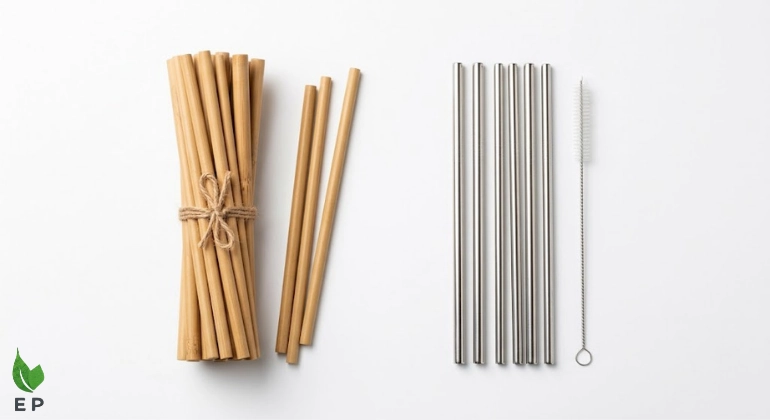
Bamboo straws are exactly what they sound like — thin, hollow segments cut and polished from naturally grown bamboo stalks. There’s no plastic lining, no synthetic coating, and no factory-grade processing beyond cleaning and smoothing the edges. That’s precisely their appeal: they feel organic in your hand, almost like drinking through a tiny piece of nature itself.
Because bamboo is a fast-growing, renewable grass rather than a tree, it regenerates quickly without needing replanting, which makes it one of the more natural materials for straws on the market. Each straw carries slight variations in color, grain, and diameter — a reminder that it came from something living rather than something molded.
These strengths make bamboo straws a favorite among people who want their everyday items to reflect sustainable living values, not just function. If you’re curious about the exact product, our bamboo straws collection shows the natural grain and finish up close.
Of course, nothing is perfect. Bamboo straws are porous by nature, which means they need more attentive straw maintenance than their metal counterparts — regular washing and occasional air-drying keep them fresh. They’re also not ideal for scalding-hot beverages, since prolonged heat exposure can gradually affect the wood grain over time. And because each one is a natural product, lifespan varies more than with manufactured steel — some bamboo straws last a year or more with good care, while others wear out sooner depending on usage frequency.
Stainless steel straws take the opposite approach: engineered precision instead of organic variation. Made from food-grade steel, they’re smooth, rigid, and built to survive years of daily use without warping, cracking, or absorbing odors. If bamboo straws feel like a small piece of nature, metal straws feel like a small piece of permanence.
This durability is exactly why stainless steel has become the go-to for people who want a “buy once, use forever” mentality. A single set can realistically outlast dozens of plastic straws — and, in many cases, several bamboo straws too.
Steel straws shine in three areas most people care about immediately: straw durability, hygiene, and versatility. Since steel is non-porous, it doesn’t retain bacteria, flavors, or odors the way organic materials can, making it easier to keep genuinely clean. It’s also excellent in terms of heat resistance of straws — you can use the same straw for iced lemonade in summer and warm tea in winter without worrying about the material degrading. Many sets, like our stainless steel reusable drinking straws set with brush, even come with a dedicated cleaning tool, which solves the “how do I clean the inside?” question most first-time buyers have.
The trade-offs are mostly about sensation and safety awareness. Steel conducts temperature quickly, so a straw sitting in a hot drink can become uncomfortably warm at the tip — something families with young kids should keep in mind. They’re also rigid, so there’s zero flex if bitten down on, and they can clink noisily against glass. None of these are dealbreakers, but they do shape who steel straws suit best.
Since a straw material comparison is easiest to absorb visually, here’s how the two stack up across the factors that actually matter day to day.
| Factor | 🎍 Bamboo Straws | 🥈 Stainless Steel Straws |
|---|---|---|
| Durability | Moderate; wears with heavy daily use | Excellent; can last for years |
| Heat Resistance | Best for cold to warm drinks | Handles hot and cold drinks well |
| Hygiene / Cleaning | Needs a brush + air drying | Non-porous, easy to sanitize |
| Weight & Feel | Light, warm, natural texture | Slightly heavier, smooth, metallic |
| Biodegradability | Fully biodegradable | Recyclable, not biodegradable |
| Cost Over Time | Lower upfront, replaced more often | Higher upfront, replaced rarely |
Looking at this table, it’s clear that neither straw is objectively “better” — they simply optimize for different priorities. Bamboo leans toward biodegradable straws and a natural feel, while steel leans toward long-term durability and consistent performance across temperatures.
Whichever material you choose, straw hygiene habits make or break the experience. For bamboo, a quick rinse right after use prevents residue from settling into the grain, and letting it air-dry upright avoids trapped moisture, which is the main cause of premature wear. A narrow bottle brush works well here — the same kind used for our sustainable bottle cleaning brush, which fits neatly into slim openings.
Steel straws are more forgiving. A dedicated straw cleaning brush run through the tube after each use, followed by an occasional soak in warm soapy water, keeps them spotless indefinitely. Because the material doesn’t absorb anything, there’s no risk of lingering smells even after months of daily coffee or smoothie use — something bamboo, being porous, simply can’t guarantee in the same way.
At first glance, bamboo straws often look like the budget-friendly choice, and in terms of upfront price, they usually are. But a proper cost comparison of straws has to factor in lifespan. A bamboo straw might need replacing every several months with heavy use, while a well-maintained steel straw can realistically serve you for years without ever needing a swap.
So the real question isn’t “which straw costs less to buy” — it’s “which straw costs less over the next two or three years.” For frequent daily users, especially families or office-goers, stainless steel often ends up being the more economical sustainable straw in the long run, even with the higher initial price tag. For occasional or seasonal users, bamboo’s lower entry cost may simply make more sense.
Here’s where lifestyle really enters the picture. If you’re someone who’s constantly on the move — commuting, traveling, grabbing coffee between meetings — portability matters as much as material. Both bamboo and steel straws travel well when paired with a proper straw carrying case or pouch, which prevents them from rattling loose in a bag or picking up lint and dust.
Picture a university student who keeps a bamboo straw tucked into their backpack for daily smoothies between classes — light, quiet, and easy to forget is even there. Now picture a parent packing lunchboxes every morning, reaching for a steel straw because it survives being tossed around, dishwasher runs, and enthusiastic little hands without a scratch. Both scenarios are valid; they just reflect different rhythms of daily life. If portability is your top priority, pairing your straw with other portable eco straws accessories — like a compact case — makes the switch from disposable habits feel effortless rather than inconvenient.
By now the pros and cons of bamboo straws and steel straws should feel less like abstract facts and more like a decision framework. To simplify things further, here’s a quick scenario-based guide:
| You are… | Better Fit | Why |
|---|---|---|
| A minimalist who loves natural materials | Bamboo | Feels organic, biodegradable, light |
| A parent with young kids | Stainless Steel | Non-breakable, easy to sanitize |
| A frequent hot-drink lover | Stainless Steel | Superior heat resistance |
| An occasional home user | Bamboo | Lower cost, simple upkeep |
| Someone who travels constantly | Stainless Steel | Long-lasting, low maintenance on the go |
If you genuinely can’t decide, many households simply keep both — bamboo for cold summer drinks at home, steel for daily commuting and hot beverages. There’s no rule saying your eco-friendly drinking accessories collection has to be limited to one material.
Switching straws is rarely a standalone decision — it usually ties into a bigger shift toward reusable drinkware and mindful consumption. Once bamboo or steel straws become part of your routine, it’s natural to look at what else in your kitchen could use an upgrade. Pairing your new straw with a reusable bamboo cutlery set or a stainless steel cutlery set rounds out a genuinely plastic-free dining kit, whether you’re eating at your desk or packing for a picnic.
For readers who want to go even deeper into comparing every reusable straw option available locally — including glass — our earlier piece on bamboo vs steel vs glass straws in Pakistan expands on this topic with even more regional context. And if you’re just starting your journey toward plastic straw alternatives across your whole household, our sustainable living guide for Pakistan is a solid roadmap for what to swap next.
Which reusable straw is right for you — bamboo or stainless steel? It depends on your priorities. Choose bamboo if you value a natural feel and biodegradability; choose stainless steel if you want maximum durability and easy hygiene across hot and cold drinks.
Are bamboo straws better than stainless steel straws? Neither is universally “better” — bamboo wins on biodegradability and natural texture, while steel wins on durability, heat resistance, and long-term cost efficiency.
How long do bamboo straws last compared to steel straws? With proper care, bamboo straws typically last several months to about a year, while stainless steel straws can last for years since the material doesn’t wear down with regular use.
Can stainless steel straws be used with hot drinks? Yes, steel handles both hot and cold beverages well, though the straw itself can heat up quickly, so sipping carefully with very hot drinks is recommended.
How do I clean a reusable straw properly? Use a slim cleaning brush for both materials right after use, followed by warm soapy water. Bamboo should be air-dried upright, while steel can be left to dry or wiped immediately.
Are bamboo straws truly biodegradable? Yes, since they’re made from natural bamboo grass with no plastic coating, they break down naturally in soil, unlike stainless steel, which is recyclable but not biodegradable.
At the end of the day, the choice between bamboo straws vs stainless steel straws comes down to how you live, not just what you drink. Bamboo offers warmth, biodegradability, and simplicity for those who want their daily habits to feel closer to nature. Stainless steel offers resilience, hygiene, and versatility for those who need one reliable tool that handles everything from morning coffee to evening lemonade. Either way, you’re stepping away from single-use plastic and toward something that lasts — and that shift matters more than most people realize.
If you’re ready to make the switch, explore our full eco-friendly product collection and find the reusable straw — or the entire plastic-free kit — that fits your life best. Small swaps like this are exactly how Pakistan’s most trusted eco-friendly store helps thousands of households move toward a genuinely sustainable everyday routine.

Subscribe our newsletter & get notification about information discount.
Subscribe to get special offers, free giveaways, and once-in-a-lifetime deals.