Still scrubbing your body with a plastic puff? Here’s why it’s time to make the switch — for your skin, your home, and the planet.
We all have that colorful plastic scrubber hanging in the shower. It feels familiar, it lathers well, and honestly — nobody really questions it. But what if that innocent-looking plastic scrubber is quietly harming your skin and polluting the environment at the same time?
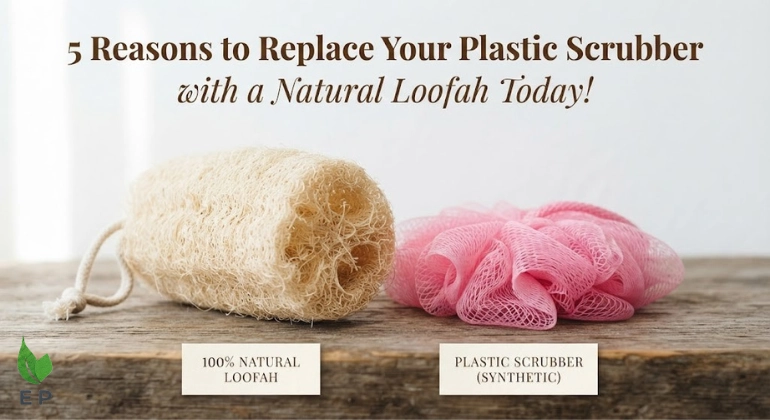
The good news? There’s a better way. The natural loofah — grown from the Luffa cylindrica plant — is one of the most powerful, skin-friendly, and eco-conscious swaps you can make today. More and more people are choosing to replace plastic scrubbers with this humble plant-based wonder, and once you understand the natural loofah benefits, you’ll wonder why you waited so long.
In this post, we’re breaking down 5 compelling reasons to switch to a natural loofah — backed by real facts, not just green marketing fluff.
Before we dive into the reasons, let’s clear up a common misconception. Many people think loofahs come from the sea — like a sea sponge. They don’t.
A natural loofah (also spelled luffa) is actually a plant-based fiber harvested from the dried fruit of the Luffa cylindrica vine — a member of the cucumber family. When the fruit matures and dries, its interior forms a fibrous, mesh-like network that works as a perfect natural exfoliating scrubber.
It’s 100% plant-derived, biodegradable, and completely free of synthetic materials. That’s already a massive win over plastic.
You can explore our Natural Loofah and Bath Loofah Sponge Pads to see what a real, high-quality natural loofah looks and feels like.
Before we get to the 5 reasons, it’s worth understanding why plastic scrubbers are bad for skin and the environment.
Here’s the uncomfortable truth:
Now that we’ve established the problem, let’s talk about the solution.
One of the most important natural loofah benefits is what it does for your skin — and it’s impressive.
A natural loofah for skin works as a gentle yet effective exfoliating scrubber. Its fibrous texture buffs away dead skin cells, unclogs pores, and stimulates blood circulation — all without the aggressive scraping that synthetic scrubbers can cause.
Here’s what makes it skin-superior:
Does loofah remove dead skin cells? Absolutely — and it does so more effectively than most plastic alternatives because the natural fiber grips and lifts dead skin rather than just sliding over it.
For a dedicated facial option, check out our Bamboo Face Brush — a perfect companion to your loofah routine for a complete green beauty routine.
This is where the plastic scrubber alternative argument becomes undeniable.
When your natural loofah reaches the end of its life (typically 4–6 weeks with proper care), you can simply toss it in your compost bin. It will break down completely within weeks — returning to the earth with zero environmental footprint.
Compare that to a plastic scrubber, which:
The numbers speak for themselves:
| Feature | Natural Loofah | Plastic Scrubber |
|---|---|---|
| Biodegradable | ✅ Yes (weeks) | ❌ No (500+ years) |
| Compostable | ✅ Yes | ❌ No |
| Microplastic Shedding | ❌ None | ✅ Yes — every use |
| Material Source | 🌿 Plant-based | 🛢️ Petroleum-based |
| End-of-life disposal | Compost bin | Landfill |
Choosing compostable bath products like a natural loofah is one of the simplest steps toward a genuine zero waste bathroom — no complicated lifestyle overhaul required.
Most people never stop to think about what their plastic scrubber is actually made of. Synthetic bath puffs are typically manufactured using nylon, polyester, or polypropylene — all petroleum-derived plastics that may contain residual chemical additives from the manufacturing process.
Every time you scrub with hot water and soap, there’s potential for trace chemical leaching directly onto your skin.
A chemical-free scrubber like a natural loofah contains:
This makes it a true eco-friendly skincare choice — especially for people with skin sensitivities, allergies, or those following a clean beauty philosophy.
Is natural loofah good for skin? Yes — precisely because of what it doesn’t contain, as much as what it does.
For a fully plastic-free bathroom experience, pair your loofah with our Bamboo Soap Dish Self-Draining Natural — it keeps your soap dry, hygienic, and chemical-free too.
Here’s a myth worth busting: “Eco-friendly products don’t work as well.”
Wrong. The natural loofah is living proof that sustainable bathing products can outperform their plastic counterparts in almost every way.
When you switch to natural loofah, you’re joining a growing movement of conscious consumers who refuse to accept the false choice between performance and sustainability. And the lifestyle benefits extend well beyond the shower:
The loofah plant itself is a remarkably sustainable crop — it grows quickly, requires minimal resources, and every part of the plant is usable. It’s one of nature’s most efficient natural fiber sponge solutions.
Want to take your sustainable bathroom further? Explore our full range of Eco-Friendly Products — from bamboo toothbrushes to reusable cutlery sets, everything you need for a genuinely green lifestyle is in one place.
You might also love our Reusable Bamboo Cutlery Set and Bamboo Straws to extend that plastic-free commitment beyond the bathroom.
One of the most common objections to natural loofahs is: “Don’t they get moldy?”
Fair question — and the honest answer is: any scrubber can harbor bacteria if not cared for properly. The difference is that a natural loofah is far easier to clean and dry than a dense plastic mesh puff.
Best way to clean a natural loofah:
How long does a natural loofah last? With proper care, a quality natural loofah lasts 4 to 8 weeks — comparable to or longer than most plastic scrubbers.
The key advantage? When it’s time to replace it, you’re not adding more plastic to the planet. You’re adding nutrients back to the soil.
For kitchen hygiene needs, our Kitchen Loofah Pads and Dish Scrub bring the same natural, hygienic scrubbing power to your sink — a perfect complement to your plastic-free bathroom goals.
How to use a loofah properly is simpler than most people think. Here’s a quick, practical guide:
Step-by-step:
Pro tip: New loofahs can feel slightly stiff. Soak yours in warm water for 2–3 minutes before first use to soften the natural fibers.
How to switch to an eco-friendly scrubber doesn’t require a dramatic bathroom overhaul. Here’s a simple, stress-free approach:
Small swaps. Real impact.
Let’s settle the loofah vs plastic scrubber debate once and for all:
| Category | Natural Loofah | Plastic Scrubber |
|---|---|---|
| Skin Exfoliation | ✅ Excellent | ⚠️ Moderate |
| Skin Safety | ✅ Chemical-free | ⚠️ Synthetic materials |
| Environmental Impact | ✅ Biodegradable | ❌ Polluting |
| Hygiene | ✅ Easy to clean & dry | ❌ Bacteria-trapping |
| Sustainability | ✅ Plant-based crop | ❌ Petroleum-derived |
| End-of-Life | ✅ Compostable | ❌ Landfill waste |
| Cost | ✅ Affordable | ✅ Affordable |
The verdict is clear. On every meaningful metric — skin health, environmental impact, hygiene, and sustainability — the natural loofah wins.
Making the switch from a plastic scrubber to a natural loofah is one of those rare decisions where everyone wins — your skin, your health, and the planet. It’s not a compromise. It’s an upgrade.
You get superior exfoliation, a chemical-free scrubbing experience, and the quiet satisfaction of knowing your daily shower routine isn’t contributing to a plastic pollution crisis. And when your loofah eventually retires? It goes back to the earth — not into a landfill.
The best natural body scrubber isn’t made in a factory from petroleum. It grows on a vine, dries in the sun, and has been used by humans for centuries. Sometimes the oldest solutions really are the best ones.
Ready to make the switch? Explore our Natural Loofah, Bath Loofah Sponge Pads, and complete range of Eco-Friendly Products at EcoProduct.pk — and start building the plastic-free bathroom you and your family deserve. 🌿

Subscribe our newsletter & get notification about information discount.
Subscribe to get special offers, free giveaways, and once-in-a-lifetime deals.