Every online seller has opened a return request and seen a cracked product inside a flimsy box. Every seller has also looked at a courier invoice and wondered why a small item cost so much to send. In most cases the problem is the box. Knowing how to choose the right box size for shipping is one of the quickest ways to cut costs, protect your products and keep customers happy.
A box that is too small crushes the product. A box that is too large wastes money, adds void fill and often triggers higher charges. The right size sits in the middle, and it is easier to find than most sellers think. This guide walks you through the whole process, from measuring your product to understanding courier pricing and picking the right material. 📦
Most new sellers treat the box as an afterthought. They grab whatever is available, stuff in some newspaper and hope for the best. Over time that habit quietly drains profit.
Box size affects three things at once. The first is shipping cost. Couriers do not only look at how heavy a parcel is. They also look at how much space it takes up on a truck or plane. A big, light box can cost more to ship than a small, heavy one.
The second is product safety. A product that slides around inside a large box takes impact on every bump. A product squeezed into a tight box has no cushioning at all. Neither one survives rough handling.
The third is customer experience. When a small lipstick arrives in a huge carton, the buyer feels the waste. When a neatly fitted package arrives, the brand looks professional and thoughtful. If you care about sustainability, which matters to many shoppers today, right-sizing is also a visible way to show it. You can read more about this in our guide to sustainable packaging solutions in Pakistan.
Before you choose any carton, you need to understand dimensional weight. It is the reason oversized boxes cost so much, and it is often the biggest hidden expense in e-commerce.
What is dimensional weight?
Dimensional weight, also called DIM weight or volumetric weight, is a pricing method used by couriers. Instead of charging only for actual weight, the courier compares the real weight with a calculated weight based on the box’s size. You are billed for whichever number is higher.
The common formula is simple:
Length × Width × Height (in cm) ÷ 5000 = Dimensional weight (in kg)
Some carriers use a slightly different divisor, so always confirm the figure with your courier before you finalize your packaging.
A practical example
Imagine you sell a ceramic mug set that weighs 1.2 kg. You ship it in a box measuring 40 × 30 × 20 cm. The volume is 24,000 cm³, and dividing by 5000 gives a dimensional weight of 4.8 kg. You are billed for 4.8 kg, not 1.2 kg.
Now repack the same set in a snug box measuring 30 × 22 × 12 cm. The volume is 7,920 cm³, which gives a dimensional weight of about 1.6 kg. That is a huge reduction in billable weight just from choosing a better-fitting carton. If you ship hundreds of parcels each month, the savings add up very quickly.
This is exactly how to reduce shipping costs with the right box size: shrink the empty space, and the billable weight shrinks with it.
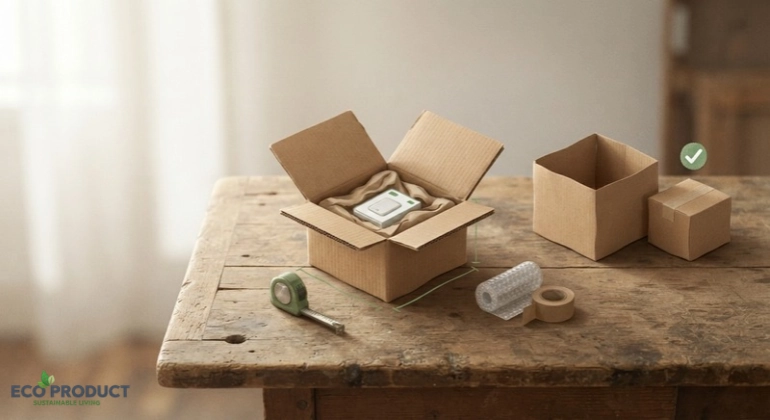
Many sellers skip this step or do it carelessly. Do not guess. Grab a measuring tape and a notebook and write down the real numbers.
How do I measure a product for shipping?
Measure the product at its widest points. Always record three numbers in the same order: length, width and height. Length is the longest side, width is the second longest and height is how tall the item stands in its packing position.
If your product has handles, spouts, lids or anything that sticks out, include them in the measurement. A bottle with a pump head, for example, is taller than the bottle alone. For soft items such as clothes or towels, measure them after they are folded and compressed the way you plan to pack them.
Measuring irregular shaped items
Round, curved or oddly shaped items can be tricky. The trick is to imagine the smallest rectangular box the item could fit inside. Measure that imaginary box. For a lamp or a vase, measure the widest point in each direction, then add the protective material you plan to wrap around it.
Once you know the product size, you must decide how much room the cushioning needs. This is where many people ask, “How much space should be left around a product in a box?”
For most items, leave about 2 to 5 cm of space on every side, which means the box’s inner dimensions should be roughly 4 to 10 cm larger than the product in each direction. Sturdy items such as books or cosmetics tubs need only a small margin. Fragile items such as glassware, ceramics or electronics need more room for cushioning.
Here is a quick reference you can use as a starting point.
| Product Type | Suggested Space Around Product | Recommended Protection |
|---|---|---|
| Clothing and textiles | 0.5–1 cm | Folded and sealed in a poly bag |
| Books and stationery | 1–2 cm | Corrugated wrap or paper fill |
| Cosmetics and personal care | 2–3 cm | Paper void fill or a small bubble wrap layer |
| Glassware and ceramics | 4–5 cm | Double layer of bubble wrap plus void fill |
| Electronics and gadgets | 4–5 cm | Original packaging plus cushioning |
This table gives general guidance. Always test your own packaging before you commit to a large order.
This is a mistake that catches many first-time buyers. Boxes are described by two sets of measurements. Inner dimensions are the usable space inside. Outer dimensions include the thickness of the cardboard walls and are what couriers use to calculate DIM weight.
When you shop for a box, compare the inner dimensions with your product plus cushioning. When you calculate shipping cost, use the outer dimensions. If a listing does not state which one it uses, ask before you order. A box that is 1 cm too small on the inside can ruin an entire batch.
Size is only half the story. The material and style of the box matter just as much, especially for heavier or fragile goods.
Corrugated cardboard is the standard choice for e-commerce because it is strong, light and recyclable. It is made from a fluted layer sandwiched between flat liners, and that structure absorbs shock well.
In Pakistan you will usually see these sold as 3-ply and 5-ply boxes. A 3-ply box is equivalent to single wall corrugated board. It is lightweight and affordable, which makes it ideal for clothing, accessories, cosmetics and other lighter products. A 5-ply box is equivalent to double wall board. It has two layers of fluting, so it handles heavier loads, stacking and rough courier handling much better.
If you want ready-to-use options, you can browse these 3-ply and 5-ply standard e-commerce boxes. For a wider overview of what is available, see our guide to e-commerce boxes in Pakistan.
Professionals measure box strength with the ECT rating, which stands for Edge Crush Test. It shows how much pressure the edge of the board can take before it collapses. A higher ECT number means a stronger box. As a rough guide, single wall boxes with a lower ECT rating suit light items, while double wall boxes with a higher ECT rating suit heavy, fragile or stacked parcels.
You do not always need to memorize the numbers. The simple rule is this: the heavier or more fragile the product, the stronger the board should be.
Not every product needs a rigid carton. Mailer boxes are a good middle ground for items such as skincare sets, gift packs and small accessories, because they give a neat presentation and decent protection. Poly mailers are lightweight plastic envelopes best suited to soft goods like T-shirts, scarves and bedsheets.
So, how do you choose between a box and a poly mailer?
| Factor | Cardboard Box | Poly Mailer |
|---|---|---|
| Protection | High | Low (soft items only) |
| Weight added | Moderate | Very low |
| Best for | Fragile, rigid or valuable items | Clothing and non-breakable goods |
| Presentation | Premium unboxing feel | Simple and practical |
| Stackability | Excellent | Poor |
If your item can be crushed, bent or broken, choose a box. If it is soft, flexible and low risk, a mailer can save you both weight and money.
Even a perfectly sized box needs the right filling. Void fill and cushioning material keep products from sliding, shaking or colliding with the walls.
Bubble wrap is a favorite for glass, electronics and ceramics because it absorbs impact. Packing paper is a cleaner, more eco-friendly option for lighter goods and for filling empty corners. Packing peanuts work well for irregular shapes, though many sellers now avoid them for environmental reasons. If you are comparing the two most common choices, our article on bubble wrap vs packing paper breaks down the pros and cons clearly.
When you are ready to buy, you can stock up on a bubble wrap roll for fragile items and explore the wider range of packaging materials for everything else.
How to pack a product so it doesn’t move in the box
The golden rule is the “shake test.” Close the box and give it a gentle shake. If you hear or feel the product moving, add more filling. If the product bulges out or the box bows, you have packed too tightly. The goal is a snug fit where the item stays still but is not under pressure.
Wrap the product first, place it in the center of the box with equal space on all sides, and fill every gap. For very fragile items, use the box-in-a-box method, where a smaller padded box sits inside a larger one.
At this point you have your product dimensions, your cushioning allowance and your box type. Now compare the numbers.
Start by adding your cushioning margin to the product dimensions. That gives you the minimum inner box size. Next, look for the closest standard box that fits. Choosing an off-the-shelf size is usually cheaper than ordering a custom size, especially when you are starting out.
Then calculate the DIM weight using the box’s outer dimensions and compare it with the actual packed weight. If the DIM weight is much higher than the real weight, try a smaller box or a different shape. Sometimes simply rotating the product so that the shortest side becomes the height can produce a smaller, cheaper box.
Finally, factor in packaging cost. A slightly more expensive box that prevents damage and returns often saves more than it costs. Remember to include tape, labels and fill in your calculation, so a roll of clear packaging tape belongs on your supplies list too.
Many sellers ask, “What are the common shipping box sizes for online stores?” Exact sizes vary by supplier, but the ranges below are typical starting points for most small businesses.
| Box Size (inches) | Typical Use |
|---|---|
| 6 × 4 × 2 | Jewelry, small accessories, cosmetics |
| 8 × 6 × 4 | Skincare sets, small gadgets |
| 10 × 8 × 4 | Books, folded clothing, gift boxes |
| 12 × 9 × 6 | Shoes, kitchenware, medium items |
| 14 × 10 × 8 | Larger gift sets, small appliances |
| 16 × 12 × 10 | Bulky or multi-item orders |
| 20 × 16 × 12 | Heavy items and bulk shipments |
Treat this as a shipping box size guide rather than a rule. Your best size is always the one that fits your own product with the right cushioning margin.
Some products need extra thought.
How big should a shipping box be for fragile items?
Fragile products need more protection than space. Aim for at least 5 cm of cushioning on every side, choose double wall board, and use layered cushioning. Seal the box with strong tape across all seams. For food items such as cakes, boxes must also hold their shape and stay level, and our guide on how to package a cake for delivery without damage covers that in detail.
Moving and bulk shipments
When you are shifting a household, box sizing follows a different logic. Use smaller boxes for heavy items like books and larger boxes for light items like bedding, so that no carton becomes too heavy to lift. Our complete guide to packing boxes for home shifting explains this in more depth, and you can browse the full range of home shifting boxes when you are ready.
It helps to see the real consequences of getting size wrong.
When the box is too big, you pay for extra void fill, extra cardboard and higher dimensional weight. The product can also shift, which increases the chance of damage. Customers may think the package looks wasteful, which hurts your brand image.
When the box is too small, the product has no cushioning and the walls take direct pressure. Corners crush, lids bulge and seams burst open during transit. You may also struggle to close and tape the box properly.
Both mistakes lead to the same result: more returns, more refunds and unhappy customers.
Right-sizing is one of the few strategies that is good for your wallet and good for the planet. Smaller boxes use less cardboard, less filler and less fuel per parcel. To go further, choose recyclable corrugated boxes, use paper-based void fill and reuse clean packaging materials where possible. Our overview of eco-friendly packaging products in Pakistan shows practical options for sellers who want to lower their environmental footprint without compromising protection.
Run through this short list before you seal any parcel:
Following the same routine for every order builds consistency, and consistency is what keeps damage rates low.
Measure your product’s length, width and height, then add 2 to 5 cm on each side for cushioning. Choose the nearest standard box that offers that much inner space.
Yes. Couriers charge based on the higher of actual weight or dimensional weight. A large box with a light product is often billed at its dimensional weight, which can be much higher than the real weight.
Multiply length × width × height in centimeters, then divide by 5000. Some couriers use a different divisor, so confirm with yours.
The best size is the smallest box that still protects the product with proper cushioning. Cutting empty space lowers both dimensional weight and filler costs.
Use a box for fragile, rigid or valuable items. Use a poly mailer for soft, non-breakable goods such as clothes and textiles.
Wrap the product, center it in the box, fill every gap with void fill and do a shake test before sealing.
Learning how to choose the right box size for shipping is not complicated, but it does take a little care. Measure your product accurately, add a sensible cushioning margin, pay attention to dimensional weight and match the box material to the product’s weight and fragility. Do this consistently and you will see lower courier bills, fewer damaged parcels and happier customers.
Right-sizing also supports a more sustainable way of doing business, because less wasted material means less waste overall. Treat your packaging as part of your brand, not just a container, and it will pay you back with every order.
Stop overpaying for oversized boxes and stop worrying about damaged parcels. Explore our range of e-commerce boxes, cushioning and tape on the Eco Product shop and find the right fit for your products today. 📦✨

Author at Eco Product — passionate about sustainable living and eco-friendly products.

Subscribe our newsletter & get notification about information discount.
Subscribe to get special offers, free giveaways, and once-in-a-lifetime deals.