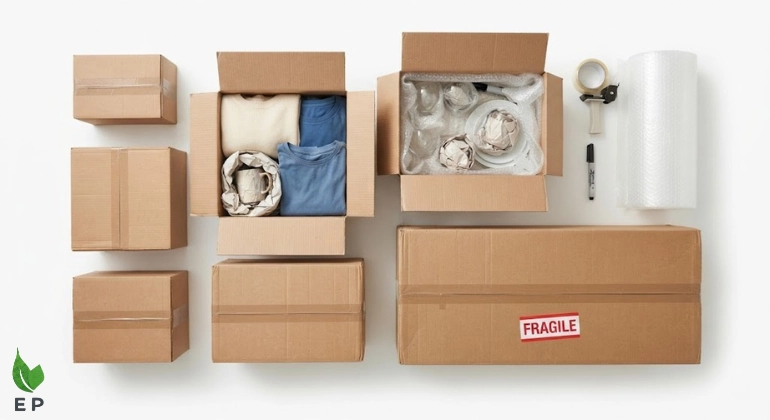
Moving to a new home is exciting, but let’s be honest — the packing part can feel like a full-time job. Choosing the right packing boxes for home shifting is where every successful move actually begins. Get this step right, and everything else — loading, transport, unloading, unpacking — becomes noticeably smoother. Get it wrong, and you’re stuck with crushed cartons, broken dishes, and boxes that split open halfway down the stairs.
This guide walks you through everything you need to know: the best box types and sizes, a room-by-room packing strategy, labeling tricks, a printable-style checklist, and answers to the questions most people search for right before moving day. Whether you’re shifting across town or across the city, by the end of this article you’ll know exactly how to pack like a pro.
It’s tempting to grab whatever free boxes you can find from the nearest grocery store. But weak, mismatched, or oversized boxes are one of the biggest causes of damaged belongings during a move.
Here’s why quality boxes make such a difference:
If you’re shifting within Pakistan, browsing a dedicated home shifting boxes collection is a smart first move — it saves you from last-minute scrambling and ensures you’re using boxes actually designed for relocation, not just leftover retail cartons.
Not all boxes are created equal. Understanding box sizes and types helps you allocate the right box to the right item, instead of guessing and hoping for the best.
Small boxes are ideal for heavy, dense items. Since the box itself is compact, it stays manageable even when fully loaded with weighty things like books, canned goods, or tools.
The most versatile size. Medium boxes work well for kitchen items, decorative pieces, and lightweight electronics — flexible enough for a wide mix of household goods.
Reserve large boxes for lightweight but bulky items like pillows, blankets, and stuffed toys. Never fill large boxes with heavy items — they become nearly impossible to lift safely.
For sturdy, moving-grade cartons, Ecoproduct’s 3-ply and 5-ply standard ecommerce boxes are a reliable pick — they’re built tougher than typical retail boxes and hold up well under stacked weight during transport.
A good move isn’t about packing fast — it’s about packing smart. Here’s a simple, proven sequence to follow.
Before a single box comes out, sort through your belongings. Donate, sell, or discard anything you haven’t used in the last year. Fewer items mean fewer boxes, lower costs, and a faster unpack on the other end.
Stock up on everything before you start, so you’re not pausing mid-pack to run errands. You’ll typically need:
You can get most of these essentials in one place — check out bubble wrap rolls, clear packaging tape, and packing rope for securing bulkier loads.
Pack one room fully before moving to the next. This keeps similar items together, makes labeling easier, and prevents that dreaded “everything mixed in one box” chaos.
This is where most people ask, “how do I even start?” Here’s a practical breakdown by category.
Kitchen items packing is often the most time-consuming part of any move because of the sheer variety — glass, ceramic, electronics, and loose utensils all in one space.
Clothes and wardrobe boxes save enormous time versus folding everything into suitcases.
If you’ve ever wondered what is the best way to pack fragile items, the answer comes down to three things: cushioning, spacing, and box strength.
Heavy items packing (books, tools, small appliances) requires smaller, denser boxes.
A few small habits make a massive difference in how smooth your move feels:
Here’s a quick, no-fuss checklist to keep on hand while you pack:
This moving checklist keeps you organized and drastically reduces last-minute panic.
Labeling boxes properly isn’t just a nice-to-have — it’s what saves you hours during unpacking.
A well-labeled box means movers place it in the right room the first time — no unnecessary lifting or guesswork.
Not sure which boxes to actually buy? Here’s what separates a good moving box from a weak one:
| Factor | What to Look For |
|---|---|
| Material | 3-ply or 5-ply corrugated cardboard for strength |
| Size Range | A mix of small, medium, large, and specialty boxes |
| Weight Capacity | Boxes rated for the item weight you’re packing |
| Closure | Boxes that fold and seal securely with tape |
| Reusability | Sturdy enough to reuse for storage after the move |
If you’re shopping locally, this ecommerce boxes in Pakistan guide is worth a read — it breaks down which box grades are best suited for different load types, and pairs well with a browse through the full packaging materials range.
This depends largely on your budget, timeline, and how much stuff you’re relocating.
DIY packing works well if:
Professional moving company services make sense if:
Many people land on a hybrid approach — packing smaller personal items themselves while hiring movers for furniture and heavy lifting.
Even experienced movers slip up here. Watch out for these:
Avoiding these small mistakes is often the real difference between a stressful move and a smooth one.
How to pack boxes for moving efficiently? Sort items by room, use the right box size for the weight of the contents, cushion fragile items properly, and label every box clearly before loading.
What is the best way to pack fragile items? Wrap each fragile item individually, add cushioning at the top and bottom of the box, and fill any empty space with packing peanuts or paper so nothing shifts in transit.
How many boxes do I need for shifting house? It depends on household size, but as a rough guide: a 1-bedroom home typically needs 20-30 boxes, a 2-3 bedroom home needs 40-60 boxes, and larger homes may need 70+.
Tips for packing kitchen items for moving? Wrap plates vertically, cushion glassware individually, use small-to-medium boxes for heavier items, and bundle sharp utensils separately with clear labeling.
Best box sizes for home relocation? A mix works best — small boxes for heavy/dense items, medium boxes for general household goods, and large boxes only for lightweight bulky items like bedding.
Step-by-step guide to packing for shifting? Declutter first, gather all supplies, pack room by room starting with least-used spaces, label everything, and finish with an essentials box for moving day.
How to label moving boxes properly? Write the destination room and contents on at least two sides, mark fragile boxes clearly, and consider a numbering system with a master inventory list.
What supplies are needed for packing boxes? Boxes in multiple sizes, packing tape, bubble wrap, packing peanuts or paper, permanent markers, and furniture blankets for larger items.
How to pack clothes for moving house? Use wardrobe boxes for hanging clothes to avoid wrinkles, fold seasonal items into medium boxes, and consider vacuum-seal bags for bulky garments.
Checklist for house shifting packing? Declutter, gather supplies, pack non-essential rooms first, wrap fragile items, label all boxes, prepare an essentials box, and confirm your moving date and transport.
Packing doesn’t have to feel overwhelming once you break it down into manageable steps. The right combination of quality packing boxes for home shifting, smart labeling, and a room-by-room strategy turns a chaotic move into a controlled, almost effortless process. Start early, stay organized, and don’t skip the small details like cushioning and clear labels — they’re what protect your belongings and your sanity on moving day.
Ready to pack smarter? Browse Ecoproduct’s full home shifting boxes and packaging materials collection and get everything you need — sturdy boxes, tape, bubble wrap, and more — in one convenient order before your next move.

Subscribe our newsletter & get notification about information discount.
Subscribe to get special offers, free giveaways, and once-in-a-lifetime deals.