Choosing between 3 ply vs 5 ply boxes sounds simple until a parcel arrives crushed, or you realize you paid for protection your product never needed. A 3 ply box is light, affordable and perfect for everyday items. A 5 ply box is thicker, stronger and built for heavy, fragile or long-distance shipments. The right choice depends on your product’s weight, how far it travels and how it will be stacked.
In this guide, we’ll unpack the difference between 3 ply and 5 ply boxes in plain language. You’ll learn how corrugated layers work, how strength is measured, and which box suits e-commerce, export, glassware, electronics or home shifting. By the end, you’ll be able to pick with confidence instead of guessing.
If you’ve ever wondered what is ply in a box, the answer is simple: “ply” means the number of layers in the corrugated board. More layers usually mean more thickness, more cushioning and higher strength. That’s why people ask how many layers does a box have before they buy.
Every corrugated box is built from two kinds of paper. The flat outer sheets are called liner board or kraft liner. The wavy layer sandwiched between them is the fluting, also known as the medium or flute layer. Together they form corrugated fiberboard, a material that is surprisingly strong for how little it weighs.
The wavy flute works like thousands of tiny arches. It absorbs shocks, resists crushing and traps air for cushioning and protection. The liners add surface strength and give you a smooth face for custom printed boxes. Most liners are made from kraft paper, which is known for its tear resistance, and many modern boxes use recycled paper content as well.
Flutes come in different sizes, and each one changes how the box behaves. A-flute is the tallest and gives the most cushioning. B-flute is thin and flat, which suits printing and stacking. C-flute sits in the middle and is the most popular general-purpose choice. A 3 ply box usually uses a single flute, while a 5 ply box combines two, often a B and C pairing, for a balanced mix of cushioning and rigidity.
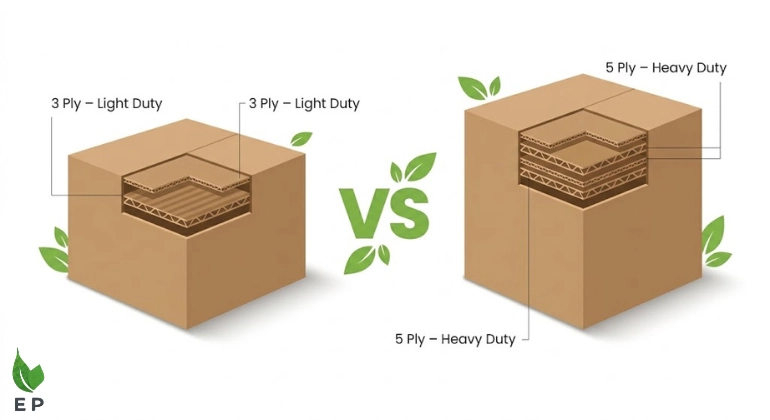
A 3 ply box (also called a 3 ply corrugated box or single wall corrugated box) has three layers: one top liner, one fluted medium and one bottom liner. It is the standard choice for light to medium-weight goods.
Think of clothing, shoes, books, cosmetics, stationery, small gadgets and bakery items. These products are light, not especially fragile and usually travel short distances. A well-made 3 ply carton box keeps them safe without adding unnecessary weight, which also helps keep courier charges down.
Typical 3 ply box uses include:
Imagine an online store selling cotton T-shirts. Each parcel weighs under one kilogram and ships within the city. A 3 ply box is the smart pick here. It is lightweight packaging, protects against dust and scuffs, and keeps the per-order packaging cost low. Using a 5 ply box for the same order would add cost without adding real benefit.
A 3 ply box has a lower load-bearing capacity. If you stack heavy cartons on top of it in a warehouse, the walls can bow. It also offers less resistance to moisture and rough handling. So is 3 ply enough for shipping? Yes, for light and moderate items. For heavy or delicate ones, it is risky.
A 5 ply box (or 5 ply corrugated box) has five layers: three flat liners and two fluted layers arranged in alternating order. This is also called double wall corrugated board. The extra flute adds thickness, rigidity and a second cushioning zone.
Two flutes mean two shock-absorbing layers. If one side takes a hit, the other helps absorb what’s left. This gives a 5 ply box higher box compression strength, better stacking strength and stronger resistance to punctures. If you’re asking which box is stronger, the 5 ply wins in nearly every category.
Common 5 ply box strength advantages:
Picture a seller shipping ceramic dinner sets from Lahore to Karachi. The box passes through a sorting hub, a truck, a second hub and a rider. At each stage it may be dropped, stacked or pressed. A 5 ply box protects the contents through all of it. This is classic glassware packaging and fragile item packaging, where a stronger box is cheaper than replacing broken goods.
So, when to use 5 ply boxes? Choose them for heavy items, fragile products, export orders, appliances, electronics, bulk storage and anything that will be stacked high or handled many times.
Here is a quick comparison of 3 ply vs 5 ply corrugated boxes so you can see the key differences at a glance.
| Feature | 3 Ply Box | 5 Ply Box |
|---|---|---|
| Layers | 2 liners + 1 flute | 3 liners + 2 flutes |
| Wall Type | Single wall | Double wall |
| Typical Thickness | Around 3–4 mm | Around 6–8 mm |
| Strength Level | Light to medium | Medium to heavy |
| Best For | Apparel, books, cosmetics | Appliances, glassware, electronics |
| Weight (box itself) | Lighter | Heavier |
| Price | Lower | Higher |
| Export Suitability | Limited | Strong |
Figures are typical industry ranges. Exact numbers vary by flute type, paper quality and manufacturer.
As the table shows, the trade-off is clear. The 3 ply box wins on cost-effective packaging and low weight. The 5 ply box wins on durable packaging and protection. Neither is “better” overall. Each is better for a different job.
Many buyers choose boxes by looks alone, but professionals rely on a few standard tests. Knowing them helps you ask suppliers the right questions.
Burst strength measures how much pressure the board can take before it ruptures. It is a good indicator of puncture resistance. The edge crush test (ECT) measures how much force the edge of the board can bear before collapsing, and it correlates closely with stacking performance. Box compression strength measures how much top-down load a finished box can handle before it crushes.
For context, common single-wall boards are often rated around 32 ECT, while double-wall boards commonly reach 44 ECT or higher. That gap is one reason the 5 ply holds up better in tall stacks.
GSM (grams per square meter) tells you how heavy and dense the paper is. Higher GSM liners generally mean stronger, more moisture-resistant boards. Box thickness matters too, but thickness alone isn’t everything. A poorly made 5 ply box with weak paper can underperform a well-made 3 ply.
Don’t ignore box dimensions either. An oversized box leaves empty space, so the product shifts and the walls bear uneven pressure. A snug fit, with proper filler, always protects better than a bigger, stronger box with too much room inside.
Now for the practical part. The best way to choose a box by product weight and use case is to think about the journey, not just the item.
For most online stores, a 3 ply box handles lightweight orders neatly. If you sell heavier or breakable items, move to 5 ply. Many sellers keep both sizes in stock and match them to each order. If you’re setting up your packaging for the first time, our guide to e-commerce boxes in Pakistan walks through sizing and sourcing, and you can browse the ready-made 3 ply and 5 ply standard e-commerce boxes to compare options directly.
Moving house puts boxes under stress. Books and kitchenware can be surprisingly heavy, and boxes get stacked in trucks for hours. Use 5 ply for heavy items such as crockery, appliances and tools, and 3 ply for clothes, bedding and soft goods. Our complete guide to packing boxes for home shifting covers room-by-room packing, and the home shifting boxes collection has the sizes you need.
Long routes mean more handling, humidity changes and heavy stacking in containers. For export packaging, 5 ply is the safer baseline, often with extra moisture protection. Always confirm the buyer’s or carrier’s requirements before finalizing your box spec.
Bakery and retail items usually need presentation as much as protection. A 3 ply box with good print quality can look premium while staying light. For delivery-specific tips, see how to package a cake for delivery without damage.
| Product Type | Recommended Box | Why |
|---|---|---|
| Clothing, shoes, books | 3 ply | Light, low cost |
| Cosmetics, stationery | 3 ply | Moderate protection is enough |
| Electronics, small appliances | 5 ply | Shock and stack protection |
| Glassware, ceramics | 5 ply | Fragile, high breakage risk |
| Heavy tools, large appliances | 5 ply | High load-bearing capacity |
| Export cartons | 5 ply | Long routes, rough handling |
The pattern is easy to remember. Light and low-risk goods go in 3 ply, and heavy, fragile or far-traveling goods go in 5 ply.
Price is where most buyers hesitate. A 5 ply box price is higher than a 3 ply box price because it uses more paper, more layers and more manufacturing steps. But the sticker price is only part of the story.
Consider what a damaged parcel really costs you: the replacement product, the return shipping, the customer’s frustration and possibly a bad review. If one in fifty orders breaks because you under-packed, the “savings” from a cheaper box disappear quickly. On the other hand, using 5 ply for every single order, including light T-shirts, means you overpay on every shipment and also pay more for weight.
The smartest approach is to balance packaging cost vs protection. Use 3 ply where it’s safe and 5 ply where it counts. That is how you reduce shipping damage without bleeding money.
A strong box is only half the solution. Inside, products need cushioning, and outside, the box needs proper sealing. Choosing between wraps and fillers matters, so our comparison of bubble wrap vs packing paper will help you decide. You can pick up bubble wrap rolls and clear packaging tape to complete the setup, or browse the full packaging materials category. A 3 ply box with good cushioning and strong tape often outperforms a 5 ply box that’s sealed badly.
Corrugated boxes are among the more sustainable packaging choices available. They’re made from renewable paper fibers, they’re widely recyclable, and many contain recycled paper content. Compared with plastic wrapping or foam, a cardboard carton breaks down far more easily after use.
Choosing the right ply also supports sustainability. A box that’s too weak leads to damaged goods, and damaged goods mean wasted products, wasted transport and wasted packaging. A box that’s too heavy wastes material. Right-sizing your packaging is itself an eco-friendly decision. If you want to go further, explore our sustainable packaging solutions in Pakistan and the wider range of eco-friendly packaging products.
Even experienced sellers slip up here. Most problems come from a handful of habits, and they’re easy to fix once you spot them.
The first mistake is choosing by thickness alone. Paper quality, GSM and flute type matter just as much. The second is ignoring the weight rating and guessing. Weigh your product, add the packing material, and then pick the box. The third is buying oversized boxes “just in case,” which leaves empty space and invites damage. The fourth is skipping a sample test. Pack a real order, drop it from waist height, shake it, and stack weight on top before ordering in bulk. The fifth is forgetting moisture. In humid or monsoon conditions, weak liners soften quickly, so higher GSM or coated board is worth the upgrade.
A simple pre-purchase checklist:
A 3 ply box has three layers (two liners and one flute) and is single wall. A 5 ply box has five layers (three liners and two flutes) and is double wall. The 5 ply is thicker and stronger, and it costs more.
Yes, for light and moderately weighted goods such as clothing, books and cosmetics on short routes. For heavy, fragile or long-distance shipments, a 5 ply box is safer.
The 5 ply box is stronger. Its double flute adds cushioning, higher stacking strength and better crush resistance.
It depends on size, paper quality and flute type, but 3 ply boxes are generally suited to light to medium loads. As a rule of thumb, move to 5 ply when the filled box starts to feel heavy or contains breakables. Always confirm with your supplier’s specifications.
Use 5 ply boxes for appliances, electronics, glassware, heavy products, export shipments and any goods that will be stacked high or handled many times.
Yes. Corrugated boxes are made from renewable fibers, are widely recyclable and often contain recycled content, which makes them one of the more sustainable packaging options.
The debate over 3 ply vs 5 ply boxes really comes down to matching protection to purpose. Choose a 3 ply box when your product is light, low-risk and travels a short distance. Choose a 5 ply box when your product is heavy, fragile, valuable or headed on a long, rough journey. Many businesses use both, and that’s often the most economical strategy.
Remember that the box is part of a system: the right size, proper cushioning, quality tape and careful packing all work together. Get those right, and either box will do its job well.
Explore our 3 ply and 5 ply standard e-commerce boxes and pair them with bubble wrap and packaging tape for a complete, damage-free setup. Visit the EcoProduct.pk shop today and ship with confidence.

Subscribe our newsletter & get notification about information discount.
Subscribe to get special offers, free giveaways, and once-in-a-lifetime deals.