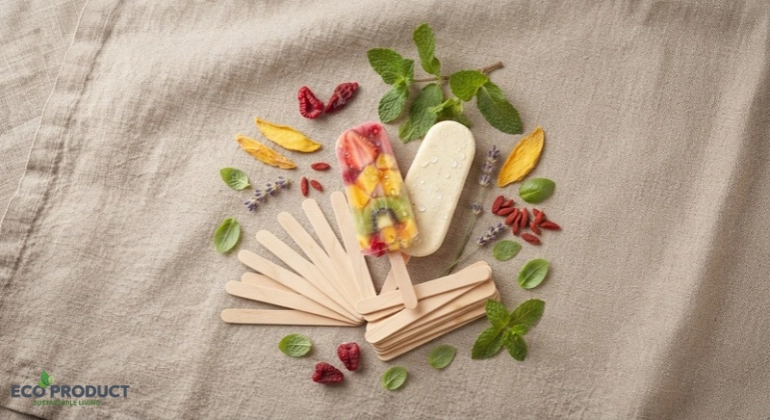
Choosing wooden craft sticks for ice cream looks like the easiest decision in a frozen dessert business, until a batch of sticks splinters, bends, or peels out of the ice cream. Many ice cream makers, home cooks and kulfi sellers have learned this the hard way. The stick is the only part of the product your customer touches, so it shapes their first impression and decides whether they enjoy the treat safely.
This guide explains how to choose the right sticks, from wood type and size to finish, safety and bulk buying. Whether you run an ice cream parlour, make homemade popsicles, or want eco-friendly disposables, you’ll know exactly what to look for by the end.
Plastic holders and sticks may be cheaper to manufacture, but wood has remained the standard for frozen desserts for good reasons. Wood has a natural, slightly absorbent surface that grips ice cream well, so the treat stays attached while your customer eats. It also doesn’t feel cold and slippery in the hand the way plastic can.
Sustainability is the other big reason. Customers in Pakistan are paying more attention to single-use plastic, and a biodegradable ice cream stick fits that shift. If you want to read more on why natural materials are replacing plastic, our guide on why birchwood cutlery is the best alternative to plastic covers the same reasoning for cutlery, and it applies equally to ice cream sticks.
There is also a branding benefit. A clean, natural wooden stick tells customers you care about quality, and that can make an ordinary kulfi or ice pop feel a little more premium.
Not all wood is suitable for food. The wood you choose affects strength, taste, smoothness and safety, so start here.
Birch wood is the most popular choice for birch wood ice cream sticks, and for good reason. It has a fine, tight grain, which gives a smooth surface and reduces the chance of splinters. It is also naturally light in colour and has very little smell or taste, so it won’t interfere with the flavour of your ice cream. Birch is strong enough to hold a heavy scoop or a dense kulfi without snapping.
Other woods, such as basswood or poplar, are sometimes used and can work well when properly processed. Cheaper, coarse-grained woods are a different story. They tend to splinter, absorb moisture unevenly, and may carry a noticeable odour. If a supplier can’t tell you what wood their sticks are made from, treat that as a warning sign.
For a quick comparison, here is how the common options stack up:
| Wood Type | Smoothness | Strength | Taste/Odour | Best For |
|---|---|---|---|---|
| Birch | Very smooth | High | Neutral | Ice cream, popsicles, kulfi |
| Basswood | Smooth | Medium | Neutral | Light popsicles, crafts |
| Poplar | Medium | Medium | Mild | Budget craft use |
| Unknown or mixed wood | Inconsistent | Unreliable | May smell | Best avoided for food |
For anything that goes into someone’s mouth, birch is the safest and most dependable pick, and you can see it in our birchwood cutlery collection.
This is where many buyers go wrong. A stick sold for school projects is not automatically safe for food. Craft sticks and food grade wooden sticks can look identical, but the way they are processed and handled can differ.
Here is why the difference matters. Sticks meant for ice cream touch a frozen product, then a person’s lips and mouth. They should be made from untreated, non-toxic wood, free of dyes, harsh chemicals, or glues that could leach into food. The sticks should also be packed hygienically, because contamination can happen long after the wood is cut.
When you evaluate a supplier, ask whether the sticks are made specifically for food contact. Reputable manufacturers can usually tell you whether their products meet recognised food-safety standards, and many describe their sticks as food-safe or FDA approved wooden sticks. Do ask for supporting documents where possible instead of relying on a label alone. If you handle any customer-facing food business, this small step protects both your customers and your reputation.
A good rule: if the sticks have a strong chemical smell, an unusual colour, or arrive in loose, dusty packaging, don’t use them for food.
Size is one of the most common questions buyers ask, and it’s easy to get wrong. The right length depends on what you are making and what mould or machine you use.
A standard ice cream stick is about 114 mm long, which suits most regular popsicles and ice pops. A larger 150 mm stick, often called a jumbo stick, gives you more room to hold on to and works well for big, heavy or thick treats. Shorter flat sticks around 93 mm are used for small bars and mini treats.
Here is a simple ice cream stick size guide:
| Stick Size | Approx. Length | Best For |
|---|---|---|
| Mini | ~93 mm | Small bars, mini ice creams |
| Standard | ~114 mm | Regular popsicles, ice pops, kulfi |
| Jumbo | ~150 mm | Large treats, DIY crafts, heavy desserts |
Sizes vary slightly between manufacturers, so always check the exact dimensions on the product page before ordering in bulk. If you are using popsicle molds, measure the slot or holder first. A stick that is too thick won’t fit, and one that is too thin will wobble and leave your ice cream crooked.
You can see the details for our own sticks on the premium quality wooden craft sticks for ice cream product page.
A stick can be made from the best birch and still be a poor product if it’s badly finished. Run your fingers along a sample. The surface should feel even and sanded, with no rough patches, sharp corners or raised fibres.
Splinter-free sticks matter more than almost any other quality. A single splinter in a child’s mouth can cause real harm and a very unhappy customer. Look closely at the edges and the rounded tip, because those are the places where cheap sticks fray first.
Also check for these quality signs:
If you are buying a large quantity, always order a sample first. It costs almost nothing and can save you from a mistake across thousands of pieces.
Many buyers don’t think about this one, but it’s very practical. Wood reacts to moisture and cold, and poor-quality sticks can swell, soften or crack in a freezer.
Good wooden ice cream sticks stay firm in the freezer and don’t bend when someone bites into the treat. They should also hold their grip on the ice cream without twisting or slipping out. To test this, freeze a small batch of your actual recipe with the sticks and check them after a day. Bend one gently and see how it responds.
A question that comes up a lot is whether you need to soak the sticks first. For ice cream and popsicles, you generally don’t. Soaking is mostly used in crafts where the wood needs to be bent or shaped. Dry, clean sticks go straight into the mould, so there is no extra preparation step for your staff or for home cooks.
Yes, in most cases, as long as the sticks are made from clean, natural, untreated wood. Many families use craft sticks for homemade popsicles and DIY frozen treats, especially in summer when kids want to help make their own ice pops.
The key is checking that the sticks are not dyed, painted or treated. Coloured craft sticks are made for decoration and may contain dyes you don’t want near food. Plain natural wooden sticks are the safest option, and it’s worth buying a pack that’s clearly labelled as food-safe.
For a simple home project, pour fruit juice, yoghurt or blended fruit into a mould, insert the stick when the mixture is slightly set so it stays upright, and freeze until firm. Using the right stick makes the difference between a neat, professional-looking ice pop and a messy one.
If you run a parlour, café, or ice cream manufacturing business, you’ll almost certainly buy in large volumes. When you shop for ice cream sticks wholesale or wooden craft sticks bulk, price is only one part of the picture.
Compare suppliers on consistency first. A pack of 1,000 sticks should have the same size, thickness and finish from the first stick to the last. Variation causes problems on production lines and in moulds. Check how the sticks are packed too, because moisture damage during storage or transport can ruin a whole carton. Good bulk packaging keeps the sticks clean, dry and protected.
It also helps to buy from a supplier who stocks related products. If you need spoons, stirrers or cutlery as well, a single reliable source simplifies ordering and keeps quality consistent. Our birchwood wooden spoons pair naturally with ice cream sticks for tubs and cups, and we also offer disposable wooden coffee stirrers if your café serves hot drinks too. You can browse everything in our shop.
Finally, think about reliability. A cheap supplier who delays deliveries in peak summer can cost you far more than a slightly higher price per pack.
More and more customers notice what their food comes with. A plastic stick that ends up in a bin or a drain is easy to criticise, while a wooden one feels like a better choice. Eco-friendly disposable sticks that break down naturally support the message many food businesses already want to send.
This isn’t just about appearance. Switching to natural materials is one of the simplest changes a business can make. If you want to go further, our post on easy zero-waste swaps in Pakistan offers more practical ideas, and our overview of eco-friendly products in Pakistan shows what else you can adopt. If you’re comparing materials in general, the article on wooden spoons versus plastic spoons explains the environmental difference clearly.
Wood is a renewable material, and when sourced responsibly it is a far better option than plastic for single-use items. Your customers may not say it out loud, but many notice and appreciate it.
Even careful buyers slip up. Here are the mistakes we see most often, explained so you can skip them.
The first is buying purely on price. Very cheap sticks are often made from low-grade wood with rough finishing, and the savings disappear the moment customers complain. The second is ignoring size. Ordering a thousand sticks that don’t fit your moulds is a costly lesson. The third is mixing up craft sticks and food sticks. They can look the same, but only sticks made for food use should go near your product. The fourth is skipping the sample, which is the cheapest quality check available.
Another common problem is poor storage. Even excellent sticks can absorb moisture and develop mould if they’re left in a damp store room. Keep them sealed, dry and away from strong smells until you need them.
Before you place an order, run through these points:
If you can tick every box, you’re ready to buy with confidence.
The right wooden craft sticks for ice cream do more than hold a dessert. They protect your customers, support your brand, and keep your production running smoothly. Focus on the wood type, check that the sticks are food-safe, match the size to your mould, inspect the finish, and buy from a supplier you can rely on. Those few steps prevent nearly every problem buyers run into.
A small decision at the start saves you from returns, complaints and wasted stock later. If you want to start with a reliable option, explore our premium wooden craft sticks for ice cream, made for ice cream makers, cafés and home users who want quality and sustainability together.
Browse our full range at EcoProduct.pk or visit the birchwood cutlery category to see every natural wooden product we offer. Message us today for bulk pricing, and let’s make your next batch of ice cream look and feel as good as it tastes. 🍦
Birch wood sticks are generally the best choice. They are smooth, strong, nearly tasteless and less likely to splinter, which makes them ideal for ice cream, popsicles and kulfi.
The most common size is around 114 mm for regular ice pops. Jumbo sticks of about 150 mm suit larger treats, and smaller sticks of about 93 mm are used for mini bars. Always check your mould size first.
They are safe when made from untreated, non-toxic, food-grade wood and packed hygienically. Avoid dyed or painted craft sticks, as they are made for decoration rather than food contact.
Yes, as long as they are plain, natural and untreated. Choose sticks labelled food-safe and avoid coloured ones.
No. Ice cream and popsicle sticks can be used dry and clean straight from the pack. Soaking is generally only useful for craft projects that involve bending the wood.
In most cases, yes. Birch has a fine grain, a smooth finish and a neutral taste, so it performs more reliably than coarse or unidentified woods.

Author at Eco Product — passionate about sustainable living and eco-friendly products.

Subscribe our newsletter & get notification about information discount.
Subscribe to get special offers, free giveaways, and once-in-a-lifetime deals.