🤔 Which Pouch Should You Choose?
Zipper pouches vs heat seal pouches is one of the first decisions a food, coffee, spice or supplement brand has to make, and it affects freshness, cost, customer experience and even how safe your product feels. Pick the wrong one and you may deal with stale products, customer complaints or wasted budget.
The good news is that the choice is simpler than it looks. A zipper pouch is built for convenience and reuse. A heat seal pouch is built for permanent protection and low cost. And in many cases, the smartest brands use both together.
In this guide we compare the two honestly, with pros, cons, a comparison table, product-by-product recommendations and practical tips. If you want to browse formats first, see our kraft stand-up pouches collection.
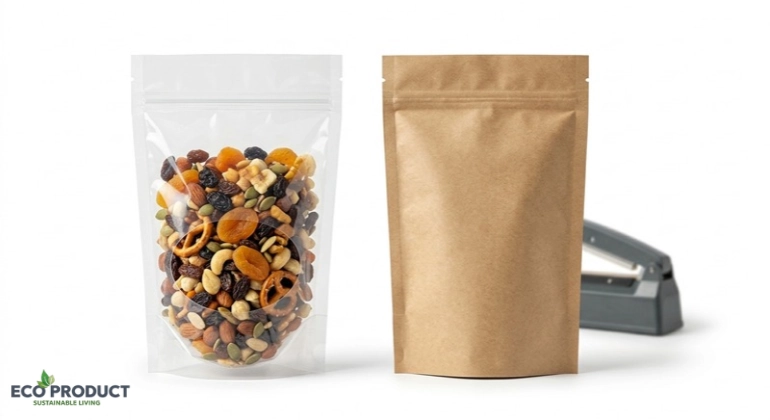
Zipper pouches, also called resealable zipper pouches, have a plastic press-to-close zipper track near the top. The customer opens the pouch, takes what they need and presses the zipper shut again. Most stand up zipper pouches use this design, which is why they are so common for snacks, dry fruits, tea and coffee.
Because the pouch can be closed repeatedly, it protects the product after the first opening, which is exactly when most packaging fails. Many styles also come with a tear notch so the customer can open the top neatly.
Popular options in our range include the clear zipper stand-up pouch (imported), the clear zipper stand-up pouch (local) and the golden clear zipper pouches.
Heat seal pouches, or heat sealable pouches, have an open top that you fill and then close with heat. A heat sealer machine or impulse sealer melts the inner layer of the film so the two sides fuse into a strong, continuous seal.
Once sealed, the pouch is closed for good. The customer must tear or cut it open. This makes the format ideal for single-use packs, sachets, ready meals and products where tamper-evident packaging matters.
Common formats include 3-side seal pouches, side gusseted pouches and flat bottom pouches. See examples like the 3-sided seal retort pouch and the white side gusseted flat bottom pouch.
One important point: many zipper pouches are also heat sealable. The zipper handles reuse for the customer, while a heat seal above the zipper gives a factory-fresh, tamper-evident closure. So the two are not always rivals.
Pros of zipper pouches:
Cons of zipper pouches:
Pros of heat seal pouches:
Cons of heat seal pouches:
| Feature | Zipper Pouches | Heat Seal Pouches |
|---|---|---|
| Closure type | Press-to-close zipper, reusable | Fused heat seal, permanent |
| Resealable | Yes | No (unless combined with a zipper) |
| Airtightness | Good for everyday use | Excellent when sealed correctly |
| Tamper-evident | Only with an added heat seal | Yes |
| Needs a machine | No | Yes (heat or impulse sealer) |
| Unit cost | Higher | Lower |
| Best for | Snacks, tea, dry fruits, supplements, coffee | Sachets, powders, long-term storage, ready meals |
| Customer convenience | High | Moderate |
In short, if the customer will open the pouch more than once, choose a zipper. If the pack is single-use or needs maximum protection and low cost, choose a heat seal. If you want both freshness and trust, choose a zipper pouch and heat seal it.
This is one of the most searched questions, so here is a straight answer. A heat seal creates a continuous bond, so heat seal pouches are generally the more airtight option, provided the film has a good barrier layer and the seal is clean. A zipper creates a tight but mechanical closure, so it protects well in daily use but is not always equal to a fused seal for long-term storage.
For sensitive products like coffee, spices and supplements, the material matters as much as the closure. Aluminium foil pouches, mylar pouches and kraft pouches with aluminium lamination offer a stronger barrier film laminate than plain clear film. Explore the aluminium foil stand-up pouch or the kraft paper with aluminum lamination pouch for better protection.
There is no single number, because freshness depends on the product, the film structure, how dry the food is and how well it was sealed. A foil-laminated pouch with a clean heat seal can protect dry foods for a long time, while a clear film pouch will offer less protection against light and oxygen. Always confirm shelf life through your own product testing rather than relying on a general claim.
Small businesses often ask how to seal a pouch without spending on industrial equipment. Here are practical options:
Always test a few pouches, then check that the seal is straight, flat and free from wrinkles or trapped product. For packing and shipping your sealed pouches safely, see our guide on bubble wrap vs packing paper.
Choosing the right pouch is easier when you start from the product:
☕ Coffee beans. Choose a foil or kraft-laminated stand-up pouch, ideally with a degassing valve. See the black coffee pouch with valve or the white stand-up pouch with valve.
🥜 Snacks and dry fruits. Zipper stand-up pouches with a clear window let customers see the product and reseal after each snack. The brown kraft stand-up pouch with window is a popular option.
🌶️ Spices and tea. Spices and tea lose flavour fast with air and light. Choose zipper pouches with a foil layer, and heat seal if you want a tamper-evident closure.
💊 Powders and supplements. A heat seal inside a zipper pouch gives the best mix of protection and trust. A moisture barrier film is essential.
🍪 Cookies and bakery items. Flat bottom pouches look neat and stand firmly on shelves. See the brown side gusseted flat bottom pouch and our bakery packaging range.
🥒 Pickles and sauces. Spout pouches or retort pouches suit liquids. Check the white stand-up pouch for pickle with window.
Cost depends on size, material, printing and quantity, so I will not quote fixed prices. What stays true is the pattern. Heat seal pouches cost less per unit because they have fewer components. Zipper pouches cost more because of the zipper, but they can save money in other ways, such as fewer complaints, less spoilage after opening and a more premium shelf presence.
For custom zipper pouches and custom heat seal pouches, bulk orders lower the per-unit price, but remember the minimum order quantity (MOQ). Startups should ask about low MOQ options or begin with stock pouches before moving to fully printed packaging. Browse our pouches to compare ready-made options.
Reusability is a strength of zipper pouches. Customers often reuse them for storing snacks, small items or travel essentials. Recycling is more complicated. Many pouches are made from flexible packaging laminates with several layers, which are harder to recycle than a single material. Kraft-based and mono-material options are more sustainable choices. For eco-friendlier choices, see our guides on eco-friendly kraft stand-up pouches, eco-friendly transparent packaging pouches and sustainable packaging solutions in Pakistan.
Use this quick decision path:
Also compare pouch shapes before you decide. Our guide to stand-up pouches vs flat pouches explains how shape affects display, cost and filling.
If you are looking for where to buy zipper pouches in Pakistan, work with a supplier that stocks multiple styles, offers samples and understands food-safe materials. A local heat seal pouches manufacturer in Pakistan also reduces lead times and import costs. Ask about food-grade materials, available sizes, printing options and MOQs before you order.
At EcoProduct.pk you can explore our kraft stand-up pouches in Pakistan, see why we are Pakistan’s trusted eco-friendly store, or browse our wider eco-friendly packaging products.
The zipper pouches vs heat seal pouches debate has no universal winner. Zipper pouches win on convenience, reusability and customer experience. Heat seal pouches win on cost, barrier strength and tamper-evidence. For most food and wellness brands, the best answer is a zipper pouch with a heat seal on top: easy for customers and safe from the factory.
Start with your product, your budget and how customers will use it. Test a few samples, check the seal quality and choose a material that matches your product’s needs.
Explore our complete pouch collection or contact the EcoProduct.pk team for help picking the right size, material and closure for your product.
1. What is the difference between zipper pouches and heat seal pouches?
Zipper pouches have a reusable press-to-close zipper. Heat seal pouches are closed permanently using heat. Zipper pouches are better for repeated use, while heat seal pouches offer stronger, lower-cost protection.
2. Which is better, a zipper pouch or a heat seal pouch?
It depends on your product. Choose a zipper pouch for resealability and convenience, and a heat seal pouch for single-use packs, tamper-evidence and lower cost.
3. Are zipper pouches airtight?
Zipper pouches close tightly and slow air and moisture well for everyday use, but a properly made heat seal is generally more airtight for long-term storage.
4. Can zipper pouches be heat sealed?
Yes. Many zipper pouches can be heat sealed above the zipper, which adds a tamper-evident closure while keeping the zipper for reuse.
5. Do I need a heat sealer for pouches?
Only for heat seal pouches. Zipper pouches close by hand, so no machine is required.
6. Are heat seal pouches tamper proof?
They are tamper-evident, because a broken or cut seal is easy to see. No packaging is completely tamper-proof.
7. Can zipper pouches be recycled?
Many are made of multi-layer materials that are difficult to recycle. Kraft-based or mono-material pouches are better choices, and zipper pouches can be reused several times.
8. Where can I buy zipper pouches in Pakistan?
You can buy ready-made zipper and stand-up pouches from packaging suppliers like EcoProduct.pk, which offers kraft, clear, foil and window pouch options.

Author at Eco Product — passionate about sustainable living and eco-friendly products.

Subscribe our newsletter & get notification about information discount.
Subscribe to get special offers, free giveaways, and once-in-a-lifetime deals.