A beautiful cake deserves a beautiful box. But more and more customers are also asking a quieter question: what happens to that box afterwards? A cake is eaten in an hour, yet its packaging can sit in a bin or landfill for far longer.
That is why eco-friendly cake packaging has moved from a “nice extra” to a real business advantage. Bakeries that choose paper-based boxes, recyclable bags and thoughtful boards send a clear message: we care about the cake, and we care about the world it lives in.
The good news is that going greener does not mean looking plain or risking your cakes. In this guide, we walk through the best materials, how to keep boxes strong and grease-free, how the terms recyclable, biodegradable and compostable differ, and how to switch step by step. Let’s start with why this matters.
Bakeries create a lot of packaging. Every cake leaves with a box, a board, often a bag, and sometimes a ribbon or sticker. Over a busy month, that adds up quickly.
Eco-conscious customers read packaging closely. A kraft box or paper bag signals care in seconds, while a cluster of plastic wraps and foam inserts can feel like a mixed message. Younger buyers in particular often share what they notice online.
Sustainability is now part of bakery branding. A bakery known for natural, responsible packaging can stand out from competitors who look identical. Many small businesses find that their packaging becomes part of their story.
Paper-based packaging is often easier to source in standard sizes, easier to store flat and easier to print. Fewer materials also means fewer things to manage.
Single-use plastic rules vary by city and change often, so check current requirements with your local authority. The general trend is toward less plastic, and moving early avoids rushed changes later.
For a wider look at the topic, our guide on sustainable packaging solutions in Pakistan is a useful companion.
Eco-friendly cake packaging is any packaging that reduces harm to the environment compared with conventional options. It usually relies on renewable or recycled materials, avoids unnecessary plastic, uses less material overall and can be recycled, reused or composted after use.
In practice, that covers the box, the board under the cake, the carry bag, the inserts and the sticker or tape. One green box inside a plastic-heavy system does not make a green bakery, so the best results come from thinking about the whole set.
Be careful with the word “eco-friendly.” It has no strict legal definition, so it works best when paired with specific, honest details such as “made from recyclable paper” or “reusable tin.”
These three terms are often mixed up, and mixing them up can damage trust. Here is a plain explanation.
Recyclable means the material can be collected and processed into new products, if a collection system exists. In many areas, including parts of Pakistan, collection can be limited, so “recyclable where facilities exist” is the more honest phrase.
Biodegradable means the material can break down naturally through microorganisms. There is no guaranteed timeframe, and conditions matter.
Compostable is the strictest term. It means the item breaks down within a set period under composting conditions, without leaving harmful residue. It usually needs certification and, often, industrial facilities.
Why does it matter? Coatings, laminations and plastic windows can change a box’s category completely. A paper box with a plastic film may not be recyclable in the same way as plain paper. Always ask your supplier exactly what the box, coating and window are made from, and describe your packaging truthfully.
Let’s go through the main pieces of a cake packaging set and look at the greener choices for each.
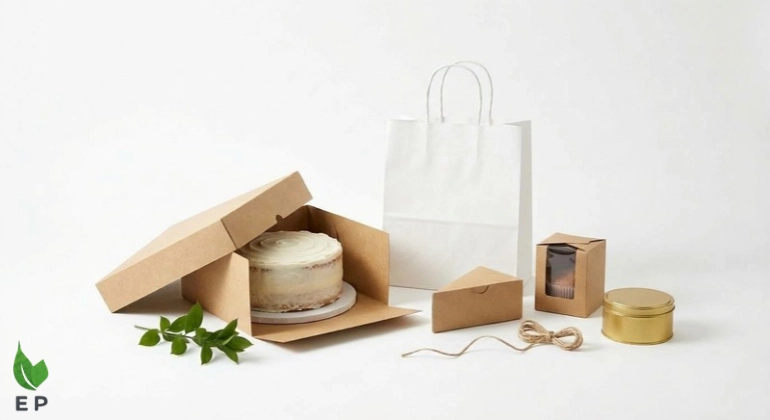
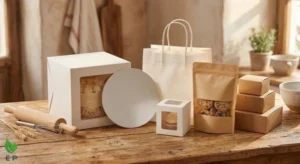
Kraft and paperboard are the backbone of sustainable cake boxes. They are made from paper fibre, which is renewable, widely recyclable where facilities exist, and easy to brand with stickers, stamps or printing. A sturdy cake box with a firm base protects the cake while keeping the material simple.
Natural kraft gives a warm, handmade feel. White and black boxes give a cleaner or more luxurious look. If you are deciding on colour, our post on black vs white cake boxes walks through branding, photos and logo contrast. For sizes, materials and structure, read our complete guide to cake boxes for bakeries.
Boards sit under every cake, yet they are often overlooked. A firm board keeps the cake level and reduces the need for extra padding or plastic supports. Choose boards that match your cake weight, because a stronger board prevents damage and wasted cakes, which is itself a sustainability win.
You can compare options in our cake boards and cake drum boards categories. If you are unsure which type you need, our comparison of cake drum boards vs regular cake boards explains the difference. Matching options include the white cake drum board and the black cake drum board.
A carry bag finishes the experience and carries your brand through the street. Paper bags are a natural fit for eco-friendly cake bags, because they replace plastic carriers with a material that is easier to recycle where facilities exist. A white paper cake bag suits a bright, friendly brand, while a black paper cake bag suits a premium one. Browse all choices in our cake bag category.
Are paper cake bags better than plastic bags? In many everyday situations, they offer a more sustainable story, especially for single-use carrying. Our post on kraft paper bags vs plastic bags and the environment explains the trade-offs in detail.
Smaller items need smaller formats. Single cake slice boxes and cupcake boxes keep portions neat and cut down on loose plastic wrap. For cookies and dry bakes, a gusseted brown bakery pouch uses less material than a rigid box and ships lighter. You can see more in our kraft stand-up pouches category.
Tins are a smart pick for gift sets and premium cookies. Customers often keep them for years, which stretches the box’s life far beyond one use. Metal is durable and widely recyclable, though it takes more energy to make than paper, so its value depends on reuse. Explore the tin boxes collection and our tin boxes buyer’s guide.
No single material does everything. The table below gives a fast view before we get into practical details.
| Packaging Piece | Eco-Friendly Choice | Best For | Watch Out For |
|---|---|---|---|
| Cake box | Kraft or paperboard box | Whole cakes, birthday and custom orders | Grease and moisture without a barrier |
| Cake board | Firm paper-based drum or board | Heavy or tiered cakes | Using a board too thin for the weight |
| Carry bag | Paper cake bag | Take-home and gifting | Overloading thin bags |
| Slice / cupcake | Small paperboard boxes | Cafes and single servings | Coatings or plastic windows |
| Cookies / dry bakes | Kraft pouch or gusseted bag | Light, dry products | Liners and laminations |
| Gift sets | Reusable tin box | Premium, keepsake gifts | Higher upfront cost |
In short, paper does most of the daily work, pouches handle dry bakes, and tins add a reusable premium option. Mix them according to what you sell.
This is the most common worry, and it deserves a straight answer. Yes, a well-made paper box can protect a cake well, but strength depends on thickness, structure, the board and how you pack.
A cake only travels safely when everything works together. A firm board stops bending. A snug box stops sliding. A cool cake holds its shape better in heat. And a flat, stable car surface beats a lap or a seat.
Here is a practical example. Hira runs a small bakery in Lahore. She used to add plastic wrap and foam to keep cakes steady. She switched to a sturdy kraft box, a firm drum board and a small non-slip mat under the board. Her damage rate stayed low, and she cut out the foam entirely. The cake was chilled before packing, and she taped the box shut with paper tape.
For a full walkthrough, read our guide on how to package a cake for delivery without damage. If you ship parcels too, our comparison of bubble wrap vs packing paper helps you choose greener padding, and our e-commerce boxes in Pakistan guide covers outer cartons.
Grease is the main enemy of paper packaging. Buttercream, ganache and oily bakes can leave marks and weaken the board over time.
The simplest fix is a barrier between the cake and the box. A grease-resistant liner, parchment sheet or food-safe paper placed under the board keeps the base clean. For slices, a paper wrapper does the same job. Let cakes set in the fridge first, because chilled frosting leaves fewer marks.
Also be careful with coatings. Some grease-resistant coatings can change how recyclable a box is, so ask your supplier what is used and whether it is food-contact suitable. As a rule, a simple liner is often a better choice than a heavy coating, because the liner can be removed or recycled separately where possible.
Are eco-friendly cake boxes food safe? Boxes made for food use are widely sold, but suitability depends on the material and supplier. Confirm food-contact suitability before using any box, and use liners when in doubt.
It depends. Costs vary by material, size, printing and quantity, so any fixed figure would go out of date quickly. Paper-based boxes and bags are often competitive with other options, especially in bulk, while specialty finishes and tins can cost more upfront.
Instead of comparing unit prices alone, look at total value. Does the packaging reduce cake damage? Does it let you charge a bit more? Does it earn more reviews and repeat orders? A slightly higher box cost can be covered by a modest price increase or fewer ruined cakes.
Here are practical ways to keep costs steady:
You can browse the range in our bakery packaging category and the shop.
A calm, planned switch beats a sudden overhaul. Follow these steps.
List every box, board, bag, wrap, sticker and filler. Note what each costs and what it does. This shows you where plastic is essential and where it is habit.
Replace plastic carry bags, extra wrap and foam inserts first. These changes are simple and visible. Move to boxes and boards next.
Test strength, fit and finish with your real cakes. Check how the box handles grease, humidity and a bumpy delivery.
Use the same colours, stickers and fonts across boxes, boards and bags. Consistent branding keeps the look premium, even on simple kraft.
Show staff how to fold, pack and seal correctly. A good box fails quickly if it is packed badly.
After a month or two, check damage rates, costs and customer feedback. Adjust sizes or suppliers based on what you learn.
Switching quietly wastes a chance to build trust. Tell customers what you changed and why, but keep the message honest.
A small card in the bag, a line on the sticker or a short social media post is usually enough. Something like “Our boxes are made from recyclable paper” works better than vague phrases such as “100% green.” Encourage reuse as well. A note such as “Reuse this bag for your next shop” costs nothing and strengthens your brand.
Does sustainable packaging help a bakery brand? Often, yes. It gives customers another reason to choose you, and it gives people something specific to talk about. For wider inspiration, our guide to eco-friendly packaging products in Pakistan shows what options exist beyond cake packaging.
Finally, be honest about limits. If you still use acrylic for certain displays, say so, and explain how you keep it to a minimum. Our guides on choosing the right acrylic box for bakery products and acrylic packaging for bakeries can help you use it wisely when it truly adds value.
Even good intentions can go wrong. Watch for these.
Over-claiming. Do not call packaging “biodegradable,” “compostable” or “plastic-free” unless your supplier can prove it, including windows, coatings and stickers.
Choosing looks over strength. A lovely box that collapses costs more than it saves. Test with a heavy cake first.
Ignoring grease. Without a liner, even a strong box can stain and weaken.
Switching everything at once. A phased change lowers risk and lets you learn.
Forgetting the unboxing. Sustainable does not mean plain. A neat sticker, ribbon or card keeps the experience special.
Eco-friendly cake packaging uses renewable, recycled or reusable materials, such as kraft and paperboard boxes, paper bags and reusable tins, while reducing unnecessary plastic.
Many paper-based cake boxes are recyclable where facilities exist, but coatings, laminations and plastic windows can change this. Confirm details with your supplier.
Plain paper fibre can break down naturally, but coatings and linings may slow or prevent this. “Biodegradable” and “compostable” are not the same, so check certification before making claims.
It varies by material, size and quantity. Paper-based options are often competitive in bulk, so compare total value, including damage rates and customer response.
Yes, when you use a sturdy box, a firm board, a snug fit and a chilled cake. Test with your real products before ordering in bulk.
Use a grease-resistant liner or parchment between the cake and the box, and chill cakes before packing.
The best eco-friendly cake packaging protects the cake, shows off your brand and respects the planet, all at once. Kraft boxes, firm boards, paper bags, small slice boxes and reusable tins each handle part of that job, and together they cover almost every cake you sell.
You do not need to change everything this week. Start with your biggest plastic habit, test one sturdy box, and tell your customers the truth about what you changed. Small, honest steps build a bakery that people trust and want to return to.
Build a matching, sustainable set today. Explore our cake boxes, pair them with cake drum boards and paper cake bags, or browse the full bakery packaging category and shop. To see why bakers trust us, read why Ecoproduct.pk is Pakistan’s most trusted eco-friendly store.

Author at Eco Product — passionate about sustainable living and eco-friendly products.

Subscribe our newsletter & get notification about information discount.
Subscribe to get special offers, free giveaways, and once-in-a-lifetime deals.