Acrylic boxes have a clear appeal. They are glossy, transparent and make almost any product look expensive. Chocolates, cosmetics, bakery treats and gift sets all look good behind that crystal-clear wall. So why are so many brands now searching for eco-friendly alternatives to acrylic packaging?
The answer is simple. Acrylic is a plastic. It comes from fossil fuels, it is rarely collected for recycling, and it lasts far longer than the few minutes most customers spend admiring it. Meanwhile, shoppers are paying more attention to what their purchases arrive in. A beautiful product in a wasteful box can feel like a mixed message.
The good news is that you do not have to choose between looking premium and being responsible. In this guide, we walk through the best sustainable options, how they compare, what they cost, and how to switch without hurting your brand. Let’s start with why acrylic is under the spotlight.
Acrylic is not a villain. It is strong, clear and reusable if the customer chooses to keep it. But as a packaging material, it has a few weaknesses that matter more every year.
Acrylic (often called PMMA) is made from petroleum-based chemicals. Like other plastics, it does not biodegrade. A discarded acrylic box can sit in landfill for a very long time.
Technically, yes. In practice, rarely. Acrylic needs to be separated from other plastics and processed in specialised facilities, and in many places, including most of Pakistan, those collection routes are limited or absent. So “recyclable in theory” often becomes “landfill in reality.” Always ask your supplier about the actual recycling options in your area before making claims.
Eco-conscious buyers read packaging closely. A kraft box or tin that clearly avoids plastic sends a message in seconds. Many small brands find that sustainable packaging becomes part of their story, and that story earns trust.
Rules on single-use plastics differ by city and province, and they change often, so always check current requirements with your local authority. The general direction is toward less plastic. Moving early avoids rushed changes later.
If you want to understand acrylic in more depth before switching, our guide on acrylic boxes vs plastic boxes explains how they differ.
Before choosing a replacement, be clear about what acrylic does for you. Most brands use it for four reasons:
A good alternative should cover as many of these as possible. The trick is to match each need with the right material, because no single replacement does everything. Some options are great for visibility, others for strength or reuse. Here is how the leading choices stack up.
Let’s go through each option and look at where it works best.
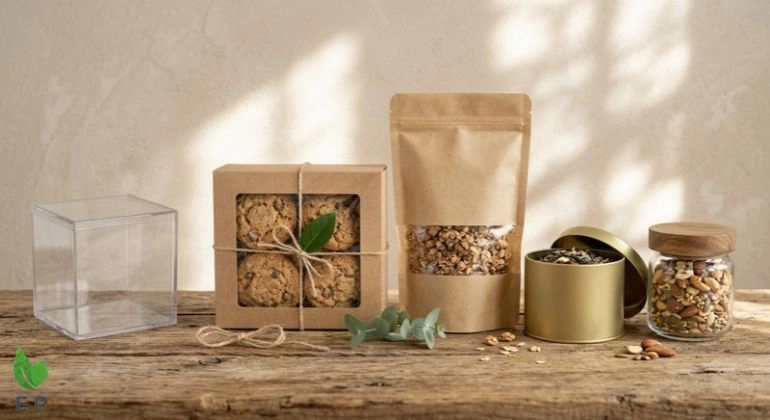
If you want the closest match to acrylic’s “see the product” benefit, a kraft box with a window is the best starting point. The box itself is made from paper, while the small window lets customers peek inside. It feels natural, honest and handmade.
Kraft is also easy to customise. A simple sticker, stamp or printed sleeve is enough to give it a boutique look. It works for cookies, sweets, soaps, candles, small gifts and dry food. You can see how a clear window pairs with paper in our brown kraft paper bags with clear front window.
One honest note: the window material matters. Plastic windows can be less sustainable than the box itself. Ask your supplier what the window is made from, and describe your packaging truthfully.
For loose products like granola, spices, coffee, nuts and snacks, pouches often beat rigid boxes. They use far less material, take up less storage space and ship lighter. That means lower freight costs and a smaller footprint.
Kraft pouches with a window give you the best of both worlds: a natural exterior and a clear view of the product. You can browse a wide range in our kraft stand-up pouches category, and compare styles such as the brown kraft stand-up pouch with window and the white kraft stand-up pouch with window.
If you are unsure about format, read our comparison of stand-up pouches vs flat pouches, or our overview of eco-friendly kraft stand-up pouches.
Tin boxes are one of the strongest answers to the question, “How do I make packaging look premium without plastic?” They feel heavy, solid and gift-worthy. Customers rarely throw them away. They reuse them for sewing kits, tea, spices, stationery and keepsakes, which stretches the box’s life far beyond a single use.
Are tin boxes eco-friendly? Generally, they are a good choice because metal is durable, reusable and widely recyclable. That said, tins use more energy to produce than paper, so their sustainability depends on reuse. A tin that lives in a kitchen for five years is a very different story from one thrown away after a week.
Tins suit cookies, chocolates, tea, gift hampers and premium sets. Explore our tin boxes collection, or choose between round tin boxes and square tin boxes. Our round vs square tin boxes guide and tin boxes buyer’s guide help you pick the right shape.
Paperboard is the everyday hero of sustainable packaging. It is lightweight, printable, widely recyclable and easy to source. Folded cartons, rigid gift boxes and corrugated shippers all belong in this family.
For retail, paperboard lets you print rich colours, add foil or emboss your logo. For shipping, corrugated boxes protect products in transit. Our guide on e-commerce boxes in Pakistan and the 3-ply and 5-ply e-commerce boxes cover the shipping side well.
For bakeries, paper-based boxes are the standard choice. They are food-friendly, sturdy and easy to brand. Read our complete cake box guide for bakeries, or browse cake boxes and the full bakery packaging category.
Glass is the classic premium material for food, candles and skincare. It is clear, non-reactive and endlessly recyclable. Customers also love reusing glass jars for storage, which keeps your brand on their shelf long after the product is gone.
The trade-offs are weight and fragility. Glass costs more to ship and needs careful cushioning. It works best for honey, jams, pickles, sauces, candles and premium creams where the glass is part of the appeal. When shipping glass, our comparison of bubble wrap vs packing paper helps you choose the right protection.
Sometimes you really do need full transparency. In that case, look for plant-based or more responsibly designed transparent packaging instead of default plastic. Options vary widely, and terms like “biodegradable” and “compostable” are not interchangeable, so check material certificates before you promise anything.
Our guide to eco-friendly transparent packaging pouches and the natural transparent pouches category are good places to start.
Let’s put the options side by side. The table below gives you a quick view before we dig into choosing.
| Option | Product Visibility | Premium Feel | Strength | Sustainability Angle |
|---|---|---|---|---|
| Acrylic box | Excellent | High | High | Plastic, rarely recycled |
| Kraft box with window | Good | Medium to high | Medium | Paper-based, recyclable |
| Kraft stand-up pouch | Good | Medium | Medium | Lightweight, less material |
| Tin box | None (unless windowed) | Very high | Very high | Reusable, recyclable metal |
| Paperboard / cardboard | Low | Medium to high | Medium to high | Widely recyclable |
| Glass jar | Excellent | High | Medium (fragile) | Reusable, highly recyclable |
No single material wins everywhere. Acrylic leads on clarity, tins on perceived luxury, kraft on natural charm and paperboard on practicality. The right answer depends on your product.
Bakeries often use acrylic for display, and for good reason. Customers love to see a cake slice or a box of macarons. But food businesses also need hygiene, grease resistance and strength.
For cakes, a sturdy paperboard cake box on a firm board is the standard. Add a paper cake bag for carrying. For cookies and brownies, a gusseted kraft pouch or a window box works beautifully. For gifting, a tin filled with cookies looks luxurious and gets reused.
Imagine a small bakery that sells cookie gift sets in clear acrylic cases. It could switch to a kraft window box with a ribbon and a branded sticker. The cookies stay visible, the look stays warm and the packaging becomes something customers feel good about. Cost often drops, too, because paper-based boxes are cheaper than acrylic.
If you still need acrylic for certain displays, our guide on how to choose the right acrylic box for bakery products helps you use it wisely. You can also explore white paper cake bags and our brown flat-bottom bakery pouch.
This is a common worry, and it deserves a straight answer. Kraft paper is stronger than most people expect. Thicker kraft board holds its shape well, and corrugated kraft handles shipping with ease.
There are a few limits to keep in mind:
For most dry goods, bakery items and gift sets, kraft performs very well. For liquids, choose a pouch or container designed for them. If you are comparing carrier options, our guide on kraft paper bags vs plastic bags and the environment shows how paper holds up in daily use. You can also browse the kraft paper bags category.
Costs vary by material, size, printing and quantity, so any fixed figure would go out of date quickly. What matters is the pattern.
Paper-based options like kraft boxes and pouches are often cheaper per unit than acrylic, especially in bulk. Tins cost more upfront but offer high perceived value and can justify a higher product price. Glass sits in the middle but adds shipping weight.
Is eco-friendly packaging worth it for small businesses? In many cases, yes. Here is why. Packaging is part of your product, not a separate cost. A better box can support a higher price, earn more reviews and encourage repeat purchases. And buying in bulk from one supplier lowers the cost per piece while keeping your look consistent.
Start small if your budget is tight. Pick one product line, test a new packaging format, and compare customer response. You can expand once you see results. Our shop lets you compare options across categories.
A calm, planned switch beats a sudden overhaul. Follow these steps.
List every box, bag, pouch and filler you use, along with what each costs and what it does. This reveals where acrylic is essential and where it is simply habit.
Use the table above. Dry snacks suit kraft pouches. Cookies suit window boxes. Gifts suit tins. Candles and jams suit glass.
Test strength, finish and fit with your real product. Check how it looks in photos too, since much of your selling happens online.
Use the same colours, stickers and fonts across all materials. A consistent look makes your brand feel premium, even on simple kraft.
A short line on the box or your social page, such as “Our packaging is plastic-free and recyclable,” goes a long way. Be accurate and avoid over-claiming.
After a month or two, check costs, damage rates and feedback. Adjust sizes or suppliers based on what you learn.
For a wider view of available options, our sustainable packaging solutions in Pakistan and eco-friendly packaging products guide are useful companions.
These words are often mixed up, so here is a plain explanation.
Recyclable means the material can be processed and turned into new products, if a collection system exists. Biodegradable means it can break down naturally through microorganisms, with no guaranteed timeframe. Compostable is the strictest term. It means the item breaks down within a set period under composting conditions, without leaving harmful residue.
Why does it matter? Because honest labels build trust. Calling a box “eco-friendly” without detail can backfire. Instead, say exactly what is true, such as “made from recyclable paper” or “reusable metal tin.” Customers appreciate clarity, and regulators do, too.
Even good intentions can go wrong. Watch out for these.
Choosing looks over fit. A beautiful box that fails in transit costs more than it saves. Always test with real shipping.
Over-claiming. Do not call packaging “100% biodegradable” or “plastic-free” unless your supplier can prove it, including the window or coating.
Switching everything at once. A phased switch reduces risk and lets you learn.
Ignoring the unboxing. Sustainable does not mean plain. Add a sticker, ribbon or card so the experience still feels special.
Forgetting the product itself. Packaging should match the product’s needs, such as moisture protection for baked goods or cushioning for glass.
The best options include kraft boxes with windows, kraft stand-up pouches, tin boxes, paperboard or cardboard boxes, glass jars and plant-based transparent packaging.
Not really. Acrylic is a petroleum-based plastic that does not biodegrade, and it is rarely collected for recycling in practice. It can be reused, but as single-use packaging it carries a heavy footprint.
Yes. Kraft boxes and pouches with windows, glass jars and some plant-based transparent options all let customers see the product.
Generally yes, especially when reused. Metal is durable and widely recyclable, and customers often keep tins for years.
For most dry goods, bakery items and gifts, yes. Thicker kraft and corrugated board are very sturdy. Wet or oily products need a food-safe liner or barrier.
Recyclable items can be processed into new products if a collection system exists. Biodegradable items break down naturally over time, with no fixed timeframe.
The search for eco-friendly alternatives to acrylic packaging is really a search for packaging that does three things at once: protects the product, represents the brand and respects the planet. Kraft windows, pouches, tins, paperboard and glass each do part of that job, and together they cover almost every product type.
You do not need to replace everything overnight. Start with one product, test one alternative and let your customers’ reactions guide you. Over time, a thoughtful switch can lower costs, strengthen your brand and give your customers something they feel good about opening.
Explore packaging that looks great and feels responsible. Browse our kraft stand-up pouches, choose from our tin boxes, or visit the full shop to build a matching set for your brand. If you still need acrylic for select displays, see our acrylic box category and our guide to the top 10 uses of clear acrylic boxes in Pakistan. To see why customers trust us, read why Ecoproduct.pk is Pakistan’s most trusted eco-friendly store.

Author at Eco Product — passionate about sustainable living and eco-friendly products.

Subscribe our newsletter & get notification about information discount.
Subscribe to get special offers, free giveaways, and once-in-a-lifetime deals.